What makes an aikuchi different from a standard tanto?
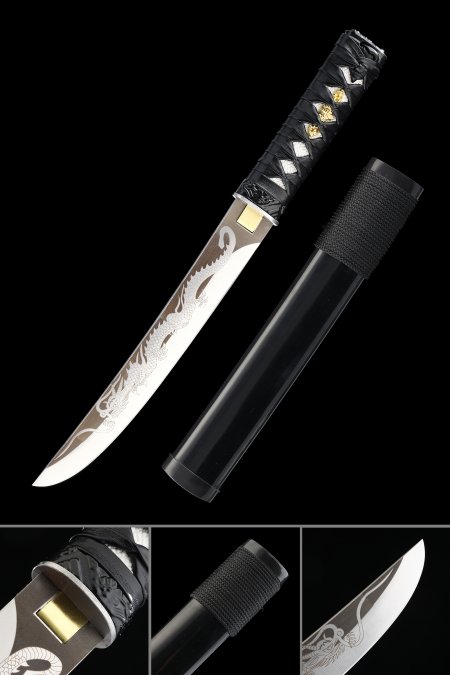
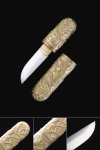
The defining feature of an aikuchi is the absence of a tsuba, or hand guard. On a standard tanto, the tsuba sits between the handle and blade as a distinct, often decoratively elaborate component. On an aikuchi, the fuchi — the collar fitting — meets the saya opening flush, so the transition from handle to scabbard is seamless. This guardless design was historically favored in formal court settings and civilian dress, where the clean silhouette was considered more refined than the overtly martial look of a guarded mounting. For collectors, it means the artistry is concentrated in the handle wrap, fittings, and scabbard rather than distributed across a separate guard piece.
What does the dragon motif symbolize on Japanese tanto collectibles?
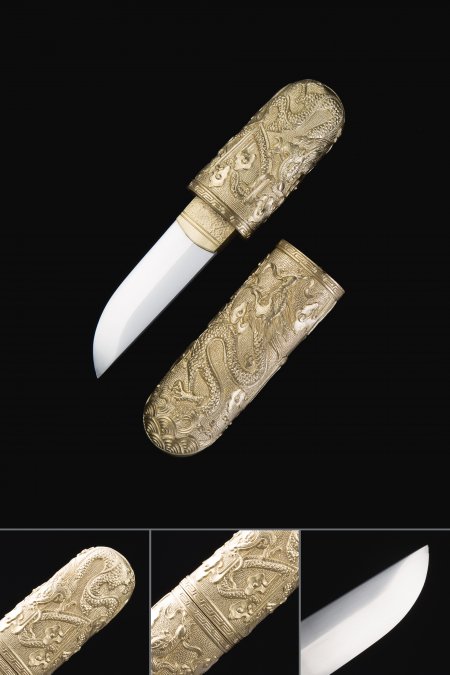
In Japanese artistic tradition, the ryū — the dragon — represents wisdom, protection, and mastery over the natural world, particularly water and storms. Unlike Western interpretations, the Japanese dragon is a benevolent guardian figure, making it an aspirational symbol for the owner of any object it adorned. On tanto fittings and scabbards, dragon engravings and cast reliefs were not decorative afterthoughts; they communicated the owner’s values and social ambitions. On the aikuchi pieces in this collection, dragon imagery appears across blade flats, copper scabbard surfaces, and cast fittings, each requiring a different engraving or casting technique to achieve clean detail at small scale.
How does manganese steel compare to stainless steel for display tanto?
Manganese steel has a naturally darker, slightly matte surface tone that pairs well with copper, brass, and antiqued gold fittings — it creates a warm, cohesive color palette suited to traditional-style display arrangements. Stainless steel, by contrast, polishes to a brighter, more reflective finish, which makes engraved line work stand out with sharper visual contrast and works well in modern or minimalist display settings. Neither material requires the same level of maintenance as high-carbon steel; both resist surface oxidation better, making them practical choices for open shelf display. If your display environment has higher ambient humidity, stainless is marginally more forgiving, while manganese benefits from occasional light oiling to preserve its surface tone.
How should I store and display an aikuchi tanto collectible?
Aikuchi tanto are best stored horizontally on a dedicated tanto stand or vertically in a display case with controlled humidity. Edge-down storage — as with full-sized Japanese swords — is not necessary for display tanto, but horizontal positioning prevents stress on the saya opening over time. Avoid direct sunlight, which can fade cord wrapping and lacquered saya surfaces. A light application of choji oil or mineral oil to the blade every few months will help maintain surface finish, particularly on manganese steel pieces. Cord-wrapped handles should be kept away from prolonged moisture exposure; if the cord shows dust accumulation, a soft dry brush rather than any liquid cleaner is the appropriate tool.
Is a dragon tsuba aikuchi a good choice as a gift for a collector?
Dragon aikuchi tanto are an excellent gift option for collectors interested in Japanese edged-tool culture, East Asian mythology, or decorative metalwork. The aikuchi format is less commonly known than the katana or wakizashi, which makes it a more distinctive choice for someone who already owns more familiar Japanese sword forms. Dragon motifs carry broadly positive symbolic meaning — wisdom, protection, and strength — that translates well across cultural contexts, making the gift legible even to recipients without deep knowledge of Japanese tradition. Pairing an aikuchi tanto with a matching tanto stand or a display-quality sword care kit elevates the presentation and provides the recipient with everything needed for proper display from day one.