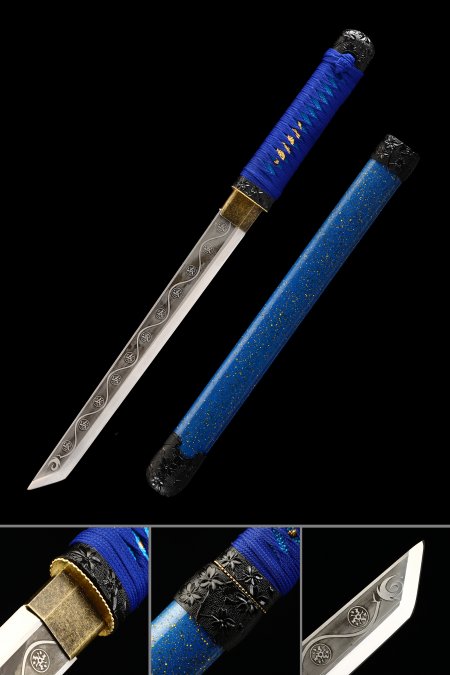
Vine Blade Hamidashi
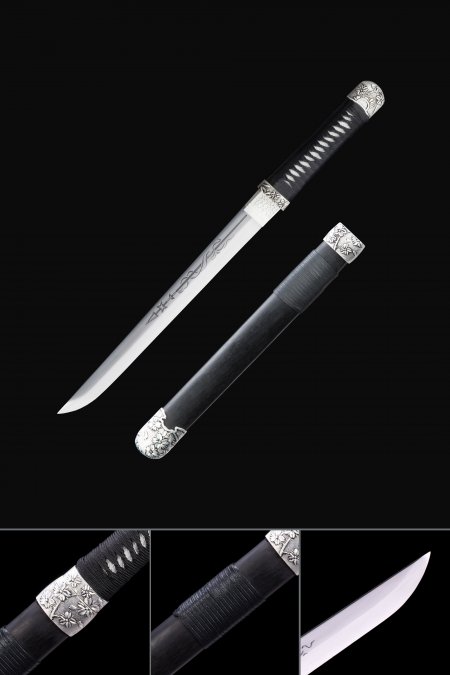
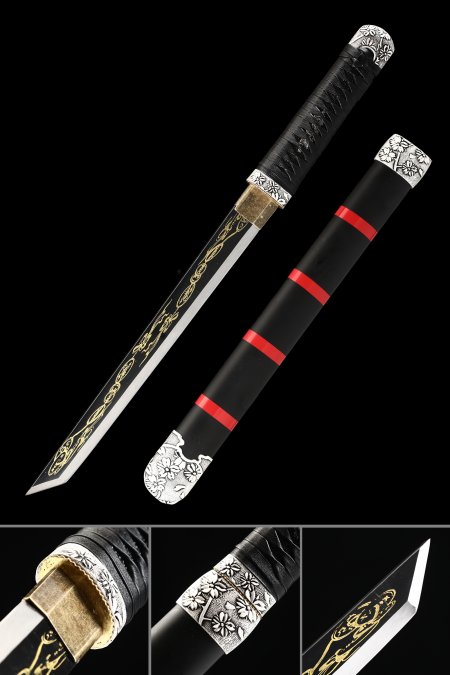
The Vine Blade Hamidashi collection brings together short-form Japanese tanto with one defining character: hand-engraved vine motifs tracing the blade's surface with botanical precision. Each piece features a hamidashi-style tsuba — a near-guardless fitting that keeps the profile compact and clean — paired with hand-wrapped handles and lacquered hardwood saya. These are purpose-crafted display collectibles, built for the shelf as much as the eye. Every order ships free with hassle-free returns.
Free Shipping
109.00 USD
ON SALE! 30% OFF
Was: 159.00 USD
Related Collections
Snake Tsuba Katana41 items
Flower Tsuba Katana61 items
Vine Saya Katana47 items
Wave Tsuba Katana40 items
Frequently Asked Questions
What makes a tanto a "hamidashi" style?
The term hamidashi refers specifically to the guard design rather than the blade itself. On a standard tanto, the tsuba is a distinct disc or shaped plate that sits visibly between the handle and the blade collar. A hamidashi tanto replaces this with a minimal guard — sometimes barely larger than the habaki it surrounds — creating a nearly guardless profile. This design emphasizes the continuity of the handle-to-blade line and gives the piece a cleaner, more austere silhouette. For display collectors, the hamidashi style reads as more refined and architectural than a tanto with a prominent tsuba.
How is the vine engraving applied to the blade?
The vine motifs on these tanto are applied through surface engraving, which cuts or etches the design into the blade flat rather than painting or printing over it. On manganese steel blades, the engraving channels appear darker against the surrounding metal because they catch less polish and allow slight oxidation to develop in the recesses — giving the vine pattern natural contrast without any added coloring. On stainless steel examples, the engraved lines reflect light differently from the polished surface, creating a subtler but still visible botanical pattern. Neither type uses paint or lacquer fill, so the engraving remains durable over the life of the display piece.
What's the practical difference between manganese and stainless steel for display tanto?
Both materials are used in this collection and each has different display characteristics. High manganese steel (typically around 65Mn grade) is harder and develops a slightly warmer, less reflective tone over time, which many collectors prefer for its more traditional appearance — the engraved vine motifs look particularly well-defined on this surface. Stainless steel maintains a brighter, more mirror-like finish with minimal care and is more resistant to surface rust in humid environments. For display pieces kept under glass or in climate-controlled rooms, either performs well. If your display space has variable humidity or limited maintenance access, stainless is the lower-maintenance choice.
How should I care for an engraved blade on a display piece?
Engraved blade surfaces require slightly more attention than smooth blades because the engraving channels can accumulate fingerprint oils, dust, and in high-humidity conditions, trace moisture. For routine care, use a soft lint-free cloth to wipe the flat of the blade after handling, and apply a thin coat of mineral oil or camellia oil every few months — working it into the engraved lines with a cotton swab to ensure coverage in the recesses. Store the tanto in its saya when not on open display, and keep it away from direct sunlight, which can fade handle cords and lacquered saya over time. Avoid silicone-based polishes, which can leave residue in engraved channels.
Does the vine motif have symbolic meaning in Japanese tradition?
Yes. The scrolling vine pattern — known in Japanese decorative arts as karakusa — is one of the most enduring motifs in East Asian design. Originating in Tang Dynasty Chinese textile and metalwork patterns and adopted extensively in Japan from the Heian period onward, the continuous interlocking vine represents longevity, growth, and unbroken lineage. It appears in everything from temple metalwork to lacquerware to textile dyeing. On a blade collectible, karakusa-style vine engraving connects the piece to a centuries-long tradition of applying botanical ornament to fine metalwork — making it a meaningful choice for collectors interested in Japanese decorative arts beyond the blade itself.
Customer Reviews
Takami Matsubara
California, United States
It looks great, nice details, doesn't shake inside the sheath, and it has a nice heavy feel. But I do wish it was more sharp for slicing, stabbing through a body was easy but slicing off a limb seemed to be difficult. It felt more like I had to chop it off like a tree. Maybe this is my personal preference but I wish it was thinner. The blade I got was 0.75 cm thick, which is thin and make the blade durable and easy to maintain. I think I cut about 15 and blade had only minor damage. But I think 0.45 ~ 0.35cm thickness will make the blade easier to slice and maneuver around.
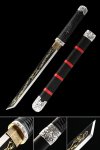 |
High Manganese Steel Hamidashi Tanto with Black Saya - Gold Engraved Blade, Silver Floral Tsuba |
Robyn
New Mexico, United States
Delivered in great shape and a couple days early! Thanks!
|
High Manganese Steel Hamidashi Tanto with Black Saya - Gold Engraved Blade, Silver Floral Tsuba |
Marcus Kirkman
Alabama, United States
Really nice a little short but the art work is awesome and fast delivery.
|
High Manganese Steel Hamidashi Tanto with Black Saya - Gold Engraved Blade, Silver Floral Tsuba |