Red Blade Hamidashi
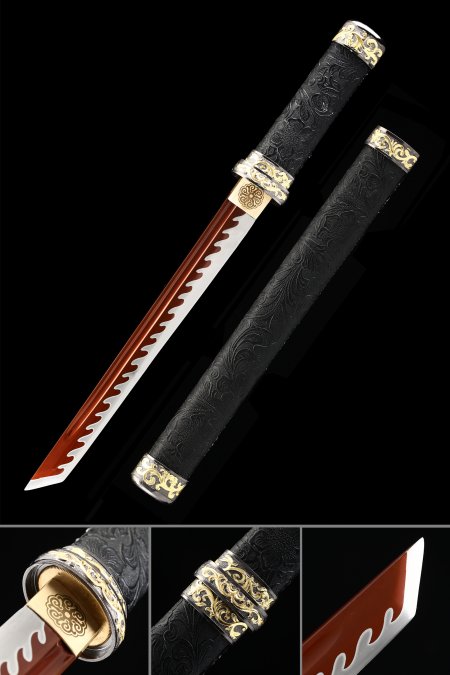
The Red Blade Hamidashi collection brings together a striking fusion of traditional Japanese tanto craftsmanship and bold aesthetic expression. Each piece features a vivid crimson-finished manganese steel blade paired with ornate scroll tsuba and hand-fitted lacquer saya - designed for display, gifting, and serious collecting. Free standard shipping on all orders, with hassle-free returns.
Related Collections
Frequently Asked Questions
What makes a hamidashi tanto different from a regular tanto?
The defining feature of a hamidashi is its half-guard - a small tsuba that extends only slightly past the edge of the hilt, rather than forming the full circular or oval guard seen on standard tanto. This compact guard gives the hamidashi a sleeker, more elongated silhouette. Historically, this style was associated with personal carry pieces where discretion and elegance mattered more than overt display. In collectible form today, the hamidashi profile is prized precisely because it looks refined rather than aggressive, making it an excellent choice for wall mounting or tabletop display where clean lines are valued.
What is manganese steel and why is it used for display blades?
Manganese steel is an alloy that includes manganese as a primary alloying element alongside carbon and iron. In collectible blade production, it is favored for its durability, resistance to surface cracking during finishing, and its ability to accept a wide range of surface treatments - including the polished, crimson-lacquered look seen in this series. Unlike high-carbon steel, which requires more intensive maintenance to prevent oxidation, manganese steel is relatively stable under normal display conditions, making it practical for collectors who want an impressive piece without intensive upkeep. It machines and finishes consistently, which helps manufacturers maintain tight tolerances on blade geometry and surface quality across a production run.
How should I care for a red-finished collectible blade?
The crimson finish on these blades is a surface treatment applied over the steel, and it benefits from gentle, consistent care. Avoid direct contact with bare hands on the blade surface - natural oils from skin can degrade the finish over time. When dusting, use a soft, lint-free cloth rather than paper towels or abrasive materials. Apply a thin coat of neutral camellia oil or Renaissance Wax to the blade every few months to protect against humidity, particularly if you live in a coastal or high-moisture environment. Store or display the tanto away from prolonged direct sunlight, which can cause surface discoloration on lacquered components including the saya. Keeping the piece in its saya when not on active display also reduces dust accumulation on the fittings.
Are the scroll tsuba on these pieces decorative or functional?
On collectible hamidashi tanto of this type, the tsuba serves primarily as a decorative and aesthetic element rather than a structural one. That said, the scroll motifs are not purely ornamental in concept - they reference a long tradition of engraved and cast tsuba produced by dedicated craftsmen known as tsubako, who were considered fine artists in Edo-period Japan. Bronze and gold-silver alloy tsuba with scrollwork patterns were associated with civilian or courtly taste rather than martial utility. For a display collector, the choice of tsuba finish - bronze for a warmer, aged look versus gold-silver for a cooler, more formal appearance - is a meaningful curatorial decision that affects the overall tone of a display arrangement.
Is a red blade hamidashi tanto a good collector gift?
It is one of the stronger options in the Japanese collectible blade category for gifting, precisely because of its visual distinctiveness. The combination of a crimson blade, lacquered saya, and ornate scroll tsuba gives it immediate impact when presented - it reads as a serious, considered object rather than a generic novelty. The hamidashi form factor is also compact enough to display comfortably in a variety of spaces, from a desk stand to a wall rack, which makes it practical for recipients without dedicated display areas. For collectors who already own conventional tanto or katana reproductions, a red blade hamidashi offers something genuinely different in terms of color palette and guard style, making it a meaningful addition rather than a duplicate.