Red Blade Manganese Steel Hamidashi
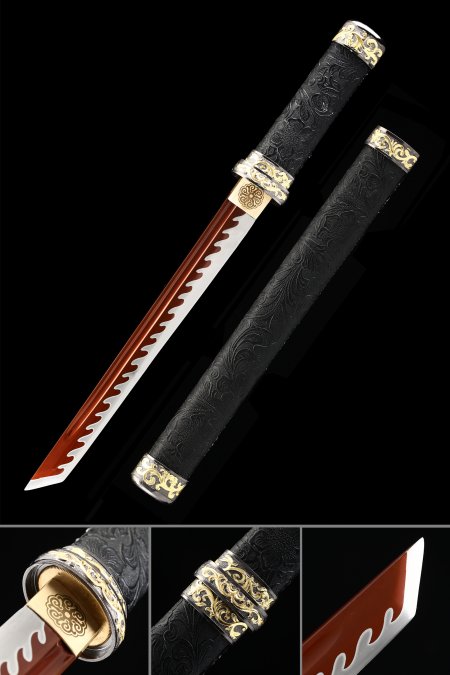
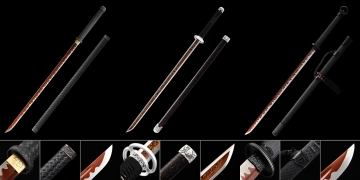
The Red Blade Manganese Steel Hamidashi collection brings together a rare pairing of striking aesthetics and dependable metallurgy. Each tanto features a vivid crimson-finished manganese steel blade housed in a compact hamidashi guard profile — where the tsuba barely clears the handle, creating a seamless, understated silhouette prized by dedicated collectors. Fittings range from gold-silver scroll tsuba to bronze accent hardware, offering distinct display personalities within a unified design language. Every piece ships with free standard shipping and is backed by our hassle-free return policy.
Related Collections
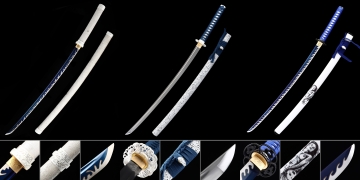
White Manganese Steel Katana14 items
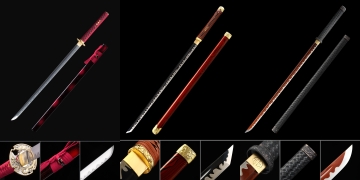
Red Manganese Steel Ninjato4 items
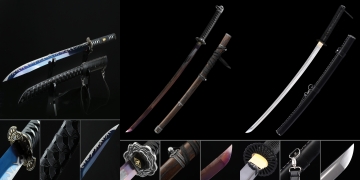
Brown Manganese Steel Katana18 items
Frequently Asked Questions
What makes a hamidashi different from a standard tanto guard?
A standard tanto tsuba is a clearly defined disc or plate that creates a visible separation between the handle and blade. A hamidashi tsuba, by contrast, is dramatically reduced in size — often little more than a shallow rim that barely extends past the circumference of the tsuka. This near-absence of guard creates a much more continuous silhouette from pommel to tip, which is why hamidashi tanto are often described as having a sleeker, more integrated profile. For collectors focused on display aesthetics, this distinction matters: the hamidashi format reads as understated and precise rather than ornate, making it an excellent complement to minimalist display setups or alongside more elaborately guarded pieces as a visual counterpoint.
How is the red finish applied to manganese steel blades?
The crimson finish on these blades is not a simple coat of paint. It is achieved through either controlled oxidation — where the steel surface is chemically treated to develop a stable red oxide layer — or through a bonded lacquer process applied directly to the prepared steel. Both methods produce a finish with visible depth: when light catches the blade at an angle, the color shifts and layers in ways a flat painted surface cannot. Manganese steel's composition actually supports this finish well, as its relatively stable surface minimizes the micro-pitting and irregularities that can cause coatings to appear uneven. For long-term display, keeping the blade lightly oiled and away from high humidity will preserve the finish's vibrancy and prevent any underlying steel from developing unwanted surface changes beneath the coating.
Does manganese steel require different care than high-carbon steel blades?
Manganese steel is generally more forgiving than traditional high-carbon steel in terms of surface toughness, but it still benefits from consistent care when used as a display collectible. The alloy's manganese content improves resistance to surface deformation, which means it holds its geometry and edge profile well over time without the micro-chipping risk associated with more brittle high-carbon compositions. That said, manganese steel is still susceptible to rust if exposed to moisture or stored in humid environments without protection. A light application of camellia oil or mineral oil every few months — applied with a soft cloth and wiped to a thin, even layer — is sufficient to maintain both the steel and any decorative surface treatment. Store the piece in its saya and avoid leaving it in direct sunlight, which can gradually affect lacquered fittings and blade coatings alike.
Which hardware variant is better for a formal display collection?
Both configurations in this collection suit formal display contexts, but they project different visual registers. The gold-silver scroll tsuba with black leather saya creates strong tonal contrast — the metallic layering of the tsuba draws the eye immediately, and the leather saya provides a textural complement to the red blade. This version tends to read as ceremonially inspired and works well in display cases with controlled lighting that can play off the metal surfaces. The bronze scroll fittings with black lacquer saya take a more unified, monochromatic approach where the hardware recedes slightly, allowing the crimson blade to dominate the composition. Bronze also develops a natural patina over years, adding long-term character. If your collection prioritizes visual drama, the gold-silver variant stands out; if you prefer a piece that evolves and deepens over time, the bronze configuration is the more rewarding long-term choice.
Is a red blade tanto a good first piece for a new collector?
A red blade hamidashi tanto is actually an excellent entry point for collectors who want a visually distinctive piece without navigating the complexity of multi-component sets or premium forging grades. The hamidashi format is historically grounded and conceptually simple to understand — its defining characteristic is immediately visible — and the red blade finish gives it an unambiguous display identity that doesn't require extensive background knowledge to appreciate. New collectors often find that starting with a piece that has a strong, specific aesthetic helps them develop their own curatorial instincts faster than beginning with something more generic. As your collection grows, a red blade hamidashi naturally anchors a themed grouping or serves as a chromatic accent among more traditionally finished pieces.