What makes a plain tsuba different from a decorative one?
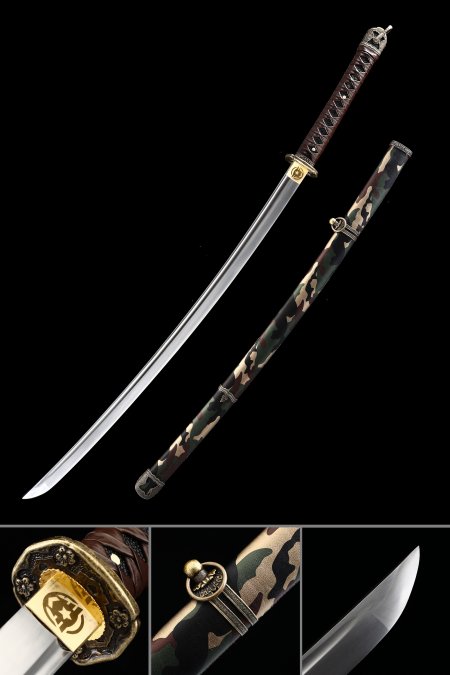
A plain tsuba - as used on Imperial Japanese military swords - is a flat, largely unornamented disc, typically made from iron or low-carbon steel, with no piercing (sukashi), inlay, or relief carving. Traditional civilian katana tsuba from the Edo period were often works of miniature art, crafted by dedicated tsuba artisans (tsubako) in schools like Goto or Owari, featuring intricate landscapes, animals, or family crests. The military plain tsuba was a conscious departure: a standardized, mass-producible component designed for uniformity across thousands of issued swords. For collectors, the plain tsuba is a direct artifact of industrial-era Japanese military culture, and its simplicity makes the overall geometry and fit of the mounting far more prominent than any surface decoration.
How does a Kyu Gunto differ from a Shin Gunto Type 98?
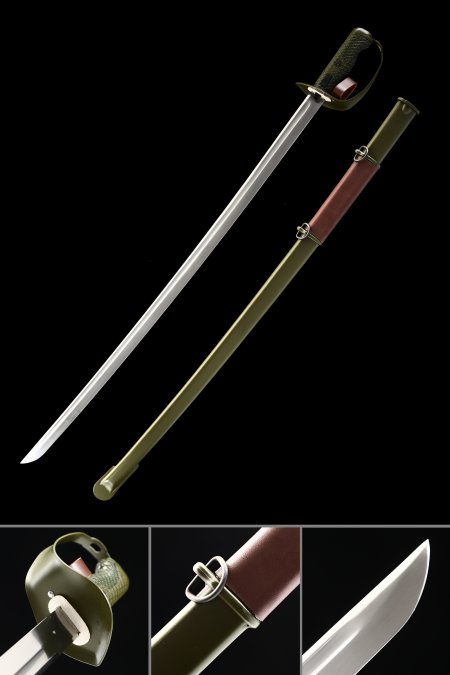
The Kyu Gunto ("old military sword") was introduced in the 1880s during Japan's Meiji-era military modernization, heavily influenced by Western cavalry saber conventions - including metal saya options and European-style suspension rings. The blade geometry leaned traditional, but the overall mounting reflected a hybrid identity. The Shin Gunto ("new military sword"), standardized as the Type 98 in 1938, reversed course by deliberately returning to classical Japanese sword aesthetics: ray skin tsuka, traditional ito braid wrap, a blade profile echoing pre-Edo katana, and a lacquered wooden saya. The Type 98 was an ideological statement as much as a design choice, signaling a renewed emphasis on Japanese cultural heritage during a period of intense nationalism. Both patterns are historically significant and distinctly different as display pieces.
Is stainless steel or manganese steel better for a display replica?
The answer depends on your display environment and personal preference. Stainless steel blades offer superior corrosion resistance, requiring minimal maintenance and retaining their bright, polished appearance for years even in humid conditions - a strong choice for collectors who display openly without frequent handling. Manganese steel blades are harder, take a slightly different edge geometry during grinding, and develop a characteristic surface tone over time that many collectors find more authentic-looking alongside aged fittings. Manganese steel does require more consistent maintenance: regular light oiling and prompt wiping of fingerprints prevent surface oxidation. Neither is objectively superior; stainless suits low-maintenance display, while manganese suits collectors who enjoy active upkeep as part of the collecting experience.
How should I store a military katana replica long-term?
Store the replica horizontally on a two-tier katana stand, with the edge facing upward and the tsuka (handle) to the right - the traditional Japanese orientation. Keep it in a stable, climate-controlled environment: aim for 40-60% relative humidity and avoid direct sunlight, which degrades wrapped handles and dries out wooden saya. Apply a thin coat of choji oil or neutral mineral oil to the blade every two to three months, always wiping off fingerprints first with a soft cloth. For replicas with leather-wrapped saya, condition the leather with a quality balm twice a year to prevent cracking. Never store a blade inside a closed saya for extended periods in high humidity without occasional airing - moisture can become trapped and cause spotting on the blade surface.
Are these swords suitable as gifts for history enthusiasts?
Military plain tsuba katana replicas make exceptionally thoughtful gifts for collectors and history enthusiasts interested in WWII, Imperial Japan, or East Asian military history. Unlike generic decorative swords, these pieces carry specific historical context - particular sword patterns, documented time periods, and accurate fittings - which gives a knowledgeable recipient genuine material to research and appreciate. For gifting, consider pairing a replica with a dedicated display stand and a small bottle of choji oil to signal that you understand the collecting context. The Shin Gunto Type 98 replica tends to resonate most with WWII history enthusiasts due to its direct connection to the Pacific theater, while the Kyu Gunto appeals to collectors interested in the broader arc of Japan's Meiji-era transformation.