What defines a hamidashi tanto compared to a standard tanto?
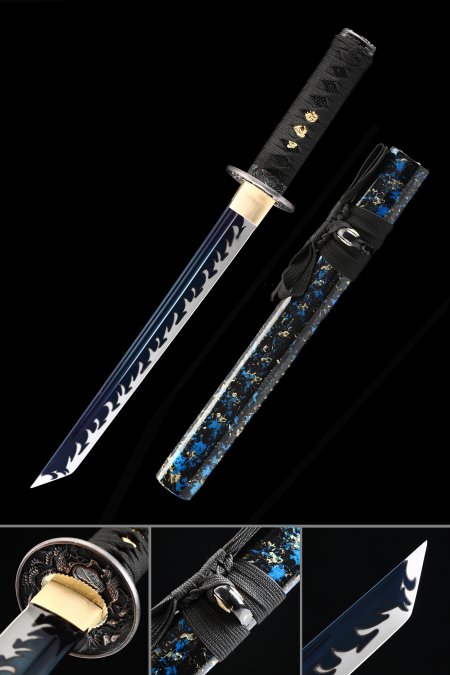
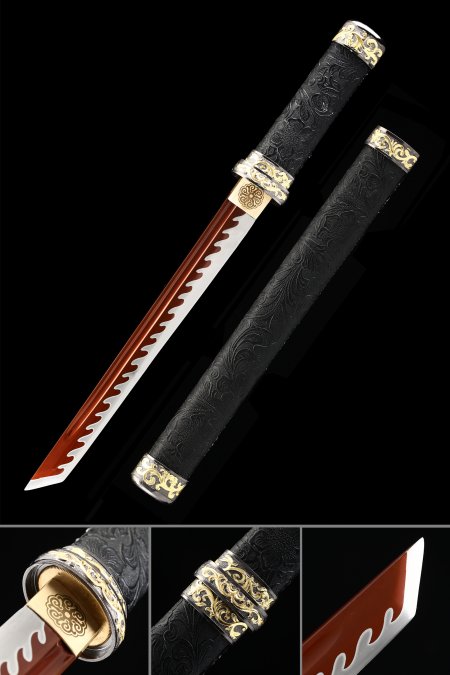
The defining feature of a hamidashi is its tsuba - a guard that extends only minimally beyond the width of the blade's spine, rather than the broader, fully circular or shaped tsuba found on standard tanto. This creates a near-seamless visual line from handle to blade. The style originates from a Japanese aesthetic preference for understatement in personal carry pieces, where conspicuous hardware was considered less refined. For collectors, the hamidashi format places all visual emphasis on blade geometry and saya finishing, making details like hamon patterns and lacquerwork far more prominent than they would appear alongside a decorative full tsuba.
How is the flame pattern on the blade actually created?
The flame effect is produced through clay tempering, a traditional process where a mixture of clay and ash is applied along the blade's spine before the steel is heated and quenched in water or oil. Because the clay-coated spine cools more slowly than the exposed edge, the two zones develop different crystalline grain structures. The visible boundary between these zones - called the hamon - takes on a wave or flame shape depending on how the clay was applied. On high manganese steel, the contrast between the hardened edge and the softer spine is especially sharp and legible, which is why these pieces display so effectively. No two hamon lines are identical, giving each blade a genuinely unique surface character.
Is high manganese steel a good choice for a display collectible?
High manganese steel offers a practical advantage for collectible tanto: it develops a distinctive surface appearance when differentially tempered, producing hamon lines with strong visual contrast. It is also relatively robust against minor surface handling and holds a polished finish well under stable indoor conditions. Compared to carbon steel, manganese steel requires slightly less aggressive maintenance in moderately humid environments, though a light application of blade oil every few months remains advisable for long-term preservation. For purely display-focused collectors, its visual characteristics - particularly the way it renders flame and wave hamon patterns - make it a well-suited material choice.
How should I display a flame blade hamidashi tanto at home?
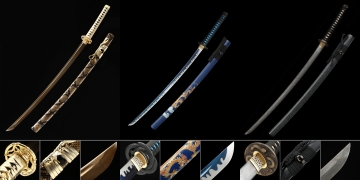
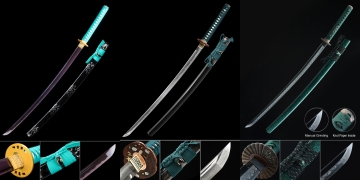
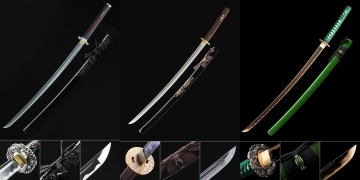
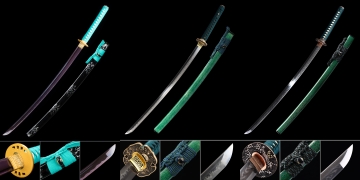
A horizontal blade stand at or slightly below eye level gives the best viewing angle for a flame hamon, allowing the undulating edge line to read clearly along the full length of the blade. Shadow box framing with a neutral fabric backing is another strong option, particularly for pieces with high-contrast color schemes like a red blade against black lacquer. Avoid direct sunlight, which can fade lacquer finishes and cause uneven oxidation on the steel over time. For multi-piece displays, pairing a hamidashi tanto with a longer katana or wakizashi from a complementary aesthetic family creates a cohesive arrangement that communicates curatorial intent rather than accumulation.
Do the tsuba on these tantos vary, and does that affect collectible value?
Yes - tsuba design is one of the most meaningful differentiators between pieces in this format. Because the hamidashi guard is small by definition, the tsuba's motif, metalwork finish, and fitting quality are immediately visible and closely scrutinized by experienced collectors. In this collection, the gold-silver scroll tsuba on the red blade tanto and the crane motif tsuba on the blue flame variant represent distinct aesthetic traditions. Crane imagery draws from classical Japanese symbolic vocabulary, while scroll metalwork reflects a more ornamental decorative sensibility. For collectors building a thematically coherent display, the tsuba choice is often the most important selection criterion after blade color.