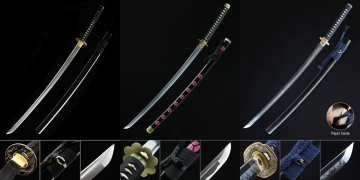
What does the black tsuba on a naginata signify?
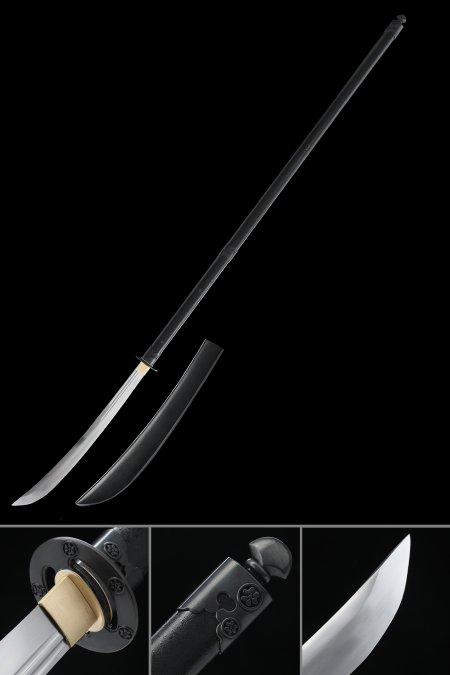
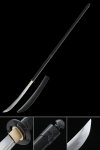
The tsuba on a naginata serves as the handguard positioned where the blade meets the handle, and a black finish — typically achieved through lacquering, blackening, or iron oxidation treatment — carries specific aesthetic weight in Japanese edged-polearm tradition. Historically, darker hardware was associated with restraint and martial refinement, as opposed to ornate gold or mixed-metal fittings used in ceremonial court pieces. For modern collectors, a black tsuba creates strong visual contrast against both bright steel and lacquered hardwood saya, making the overall display composition more cohesive. It also tends to photograph with greater definition under natural or gallery lighting, which is a practical consideration for collectors who document their pieces.
How does T10 clay-tempered steel differ from 1060 carbon steel in a naginata?
T10 and 1060 are both high-carbon steels, but they differ in composition and the finishing techniques available to the smith. T10 contains trace tungsten, which improves wear resistance and allows the steel to hold a refined geometry at the edge. More importantly, T10 responds exceptionally well to clay tempering — a process where the smith applies clay along the spine before quenching, creating a differential hardness between edge and spine. This produces a genuine hamon: the visible crystalline temper line that is the hallmark of authentic Japanese forging. 1060 steel, by contrast, is a straightforward high-carbon alloy that is more forgiving to forge and finish, making it an excellent foundation for collectors who prioritize structural integrity and clean geometry over the visual complexity of a hamon. Both are valid choices depending on what a collector values in a display piece.
Is a full-tang naginata better for display than a partial-tang version?
Full-tang construction — where the steel extends the full length of the handle — is generally preferred by serious collectors for several reasons beyond structural integrity. It contributes to more authentic balance distribution along the polearm’s length, which affects how the piece sits in a horizontal floor stand or wall mount. A full-tang naginata also tends to have tighter handle assembly with less risk of loosening over years of static display, particularly in environments with seasonal humidity changes that cause wood to expand and contract. From an authentication standpoint, full-tang construction is a mark of quality that distinguishes hand-forged collector pieces from decorative replicas built around threaded rod or dowel cores.
How should I care for a lacquered saya on a naginata?
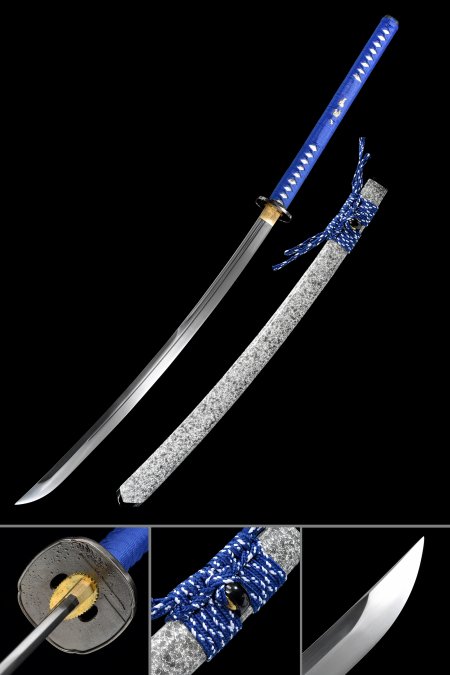
Lacquered saya — whether black, blue, or white — require different care than bare wood. Avoid applying any oil-based product directly to the lacquer surface, as it can cloud the finish over time. Instead, use a dry microfiber cloth to remove dust, and if fingerprints or smudging are present, a lightly dampened cloth followed immediately by a dry pass is sufficient. Keep the saya away from direct sunlight, which will fade colored lacquer finishes unevenly, and from heat sources that can cause the wood beneath to dry and crack, compromising the lacquer adhesion. When storing, lay the naginata on padded supports rather than resting the saya on hard surfaces, which can chip the lacquer at contact points. These steps will preserve the visual quality of the saya for years of display.
What display setup works best for a naginata at home?
A naginata’s length — typically ranging from five to seven feet including the handle — requires more deliberate planning than a katana display. Horizontal wall mounts with two padded support points are the most common solution; the mount should be spaced to support both the upper blade area and the lower handle without the piece bowing under its own weight. Floor stands designed for naginata or yari are also available and work well in corner placements. Orient the blade with the edge facing upward on a horizontal mount to minimize stress on the habaki over time. For a multi-piece display alongside shorter blades, placing the naginata as a vertical or angled anchor piece creates visual hierarchy. Consider the wall surface load rating when using wall mounts, as a full-tang hand-forged naginata carries meaningful weight.