What makes a hamidashi tanto different from a standard tanto?
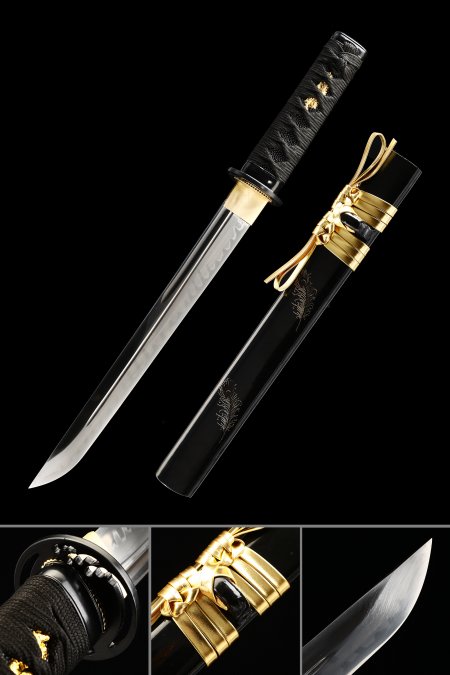
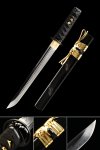
The defining difference lies in the guard. A standard tanto uses a full-sized tsuba — a circular or shaped hand guard that sits visibly between the blade and handle. A hamidashi tanto replaces this with a ko-tsuba, a very small guard that barely extends beyond the profile of the handle itself. The result is a much smoother, more continuous silhouette from handle to blade, giving the piece an elegant, understated look that many collectors prefer for display. Historically, hamidashi tanto were associated with refined civilian use rather than battlefield carry, which makes them a natural fit for the decorative and collectible market.
How does a real hamon form on T10 carbon steel?
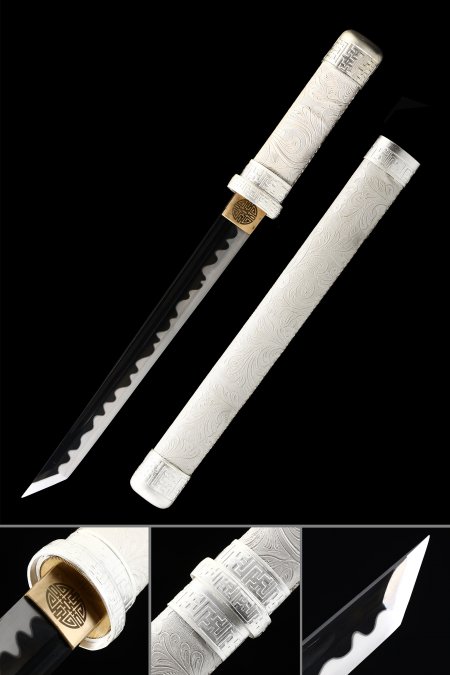
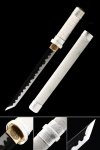
A hamon is produced through a process called differential hardening, or tsuchioki. A clay mixture is applied along the spine of the blade before the final quench — thicker along the back, thinner or absent near the edge. When the blade is heated and quenched in water or oil, the exposed edge cools rapidly and hardens into a martensitic crystalline structure, while the clay-insulated spine cools slowly and remains softer. The boundary between these two zones creates the visible hamon line. T10 carbon steel, with its relatively high carbon content and fine grain, responds particularly well to this technique, producing a hamon with strong visual definition and subtle activity along the transition zone. Each hamon is unique — no two blades will show identical patterns.
What is the vine motif on the saya, and how is it applied?
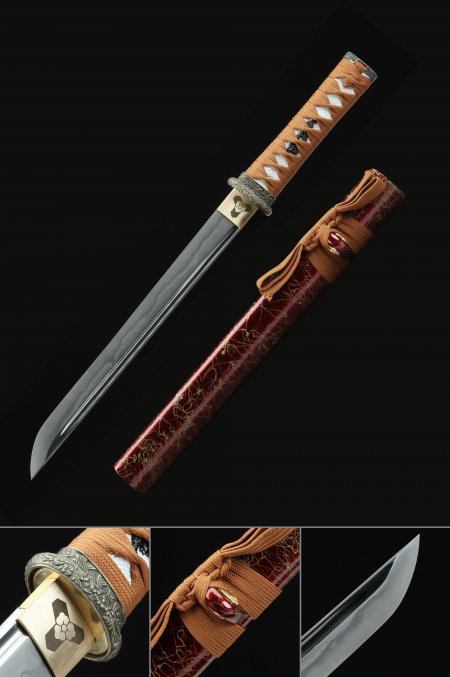
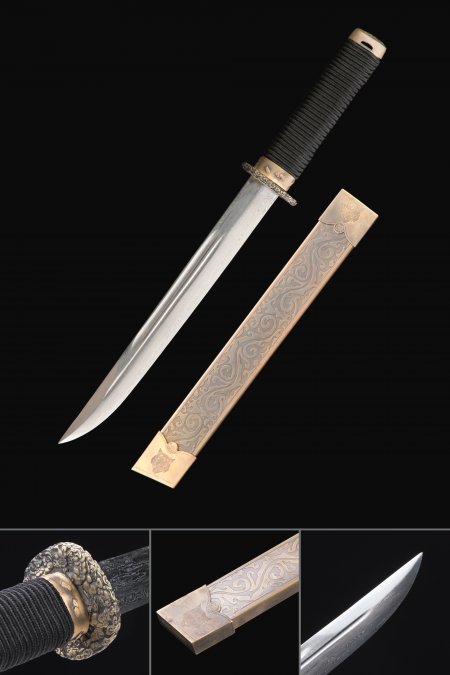
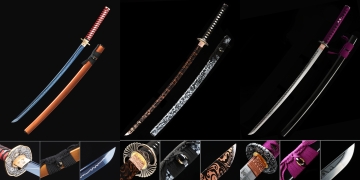
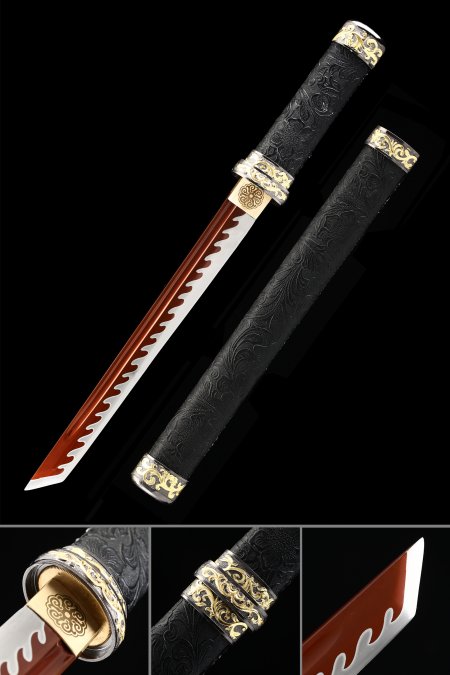
The vine motif — known in Japanese decorative arts as karakusa when stylized — is a scrolling, trailing plant pattern with deep roots in classical Japanese and East Asian ornamentation. In this collection, the motif appears across several saya construction types. On lacquered wood saya, the pattern may be carved into the substrate before lacquer application, creating a raised relief effect that catches light from different angles. On copper saya, the design is hand-engraved directly into the metal surface, producing crisp line definition with an aged, artisanal quality. On leather saya, tooling presses the pattern into the surface of the material. Each method produces a visually distinct texture while keeping the overall aesthetic language consistent across the collection.
How should I store and maintain a lacquered saya tanto?
Lacquered saya require moderate care to preserve their finish over time. Avoid storing the piece in direct sunlight, which can cause lacquer to yellow or crack over years of exposure. High humidity environments are also problematic — the lacquer itself is relatively stable, but the wood substrate beneath can expand and warp if moisture penetrates any micro-cracks. A stable indoor environment between 40–60% relative humidity is ideal. For the blade, apply a thin coat of choji oil or a comparable mineral oil every few months using a soft cloth or cotton pad, then wipe away any excess. Never store the blade in the saya long-term without this protective coat, as condensation can cause surface oxidation even on high-carbon steels.
Is Damascus steel tanto a good choice as a collectible display piece?
Damascus steel — constructed from multiple layers of folded and forge-welded steel — is one of the most visually striking choices for a display collectible. The layering process, followed by acid etching, reveals a flowing grain pattern across the blade surface that is entirely unique to each individual piece. No two Damascus blades share the same pattern, which gives each item a degree of individuality that collectors value. In the context of a decorative tanto, the Damascus surface works particularly well when paired with engraved or textured fittings, since the visual complexity of the blade is complemented rather than overwhelmed by equally detailed hardware. For display purposes, a light coat of oil applied periodically will preserve the etched surface and prevent any dulling of the pattern over time.