Snake Tsuba Wakizashi

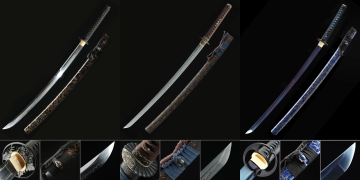
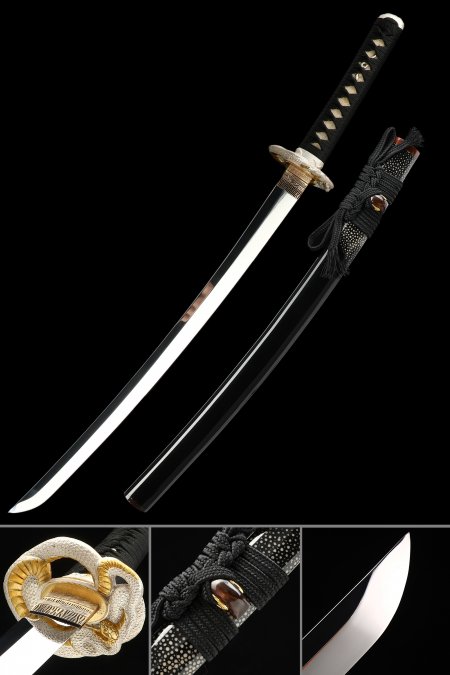
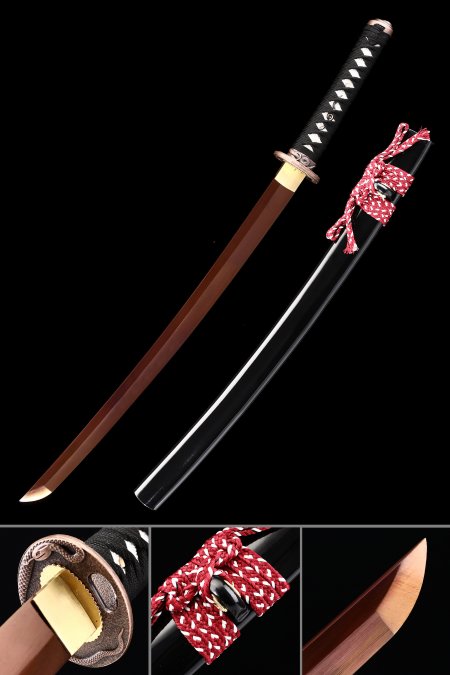
Snake tsuba wakizashi occupy a distinctive corner of Japanese sword collecting — where classical short-blade proportions meet bold, nature-inspired fittings. Each piece in this collection features a hand-crafted serpent guard rendered in brass or iron, paired with quality steel blades finished to collector standards. From folded steel with genuine hamon to high-manganese alloys with dramatic blade geometry, every sword is assembled with full-tang construction and traditionally matched koshirae. Complimentary shipping is included on all orders, and we stand behind every purchase with a hassle-free return policy.
Showing 4 Products

Related Collections

Snake Tsuba Katana41 items


86 Reviews

Flower Tsuba Katana61 items


389 Reviews

Wave Blade Katana83 items


138 Reviews

Vine Saya Katana47 items


297 Reviews

Frequently Asked Questions

What steel types are used in snake tsuba wakizashi?
The collection spans three distinct blade materials, each with different visual and structural qualities. High-manganese steel produces blades with notable surface hardness and a bright, polished finish — often chosen for dramatic gold or dark-toned presentations. 1095 high-carbon steel is a classic choice among collectors for its clean grain and capacity to hold a well-defined polish. The most visually complex option is 1000-layer folded steel, where repeated forge-welding creates a subtle surface pattern and, when combined with differential hardening, a visible hamon along the temper line. Each steel type results in a meaningfully different blade character, which makes steel selection one of the first and most important decisions when adding a piece to a collection.
How is a snake tsuba different from a standard iron guard?
A standard iron tsuba is typically a flat disc with minimal surface relief — functional in origin, valued today more for its form than ornamentation. A snake tsuba is a sculptural object: the serpent's body is rendered in dimensional relief, often with scaled texture, coiled posture, and a head positioned near the blade opening. Most examples in this collection use brass, which allows for finer detail casting and develops a warm patina over time. The difference is immediately apparent in hand — a snake tsuba has weight distribution shaped by its form, not just its material, and functions as a standalone piece of decorative metalwork that happens to also serve as a sword guard.
How should I store a wakizashi to preserve the blade and fittings?
Horizontal storage in a sword stand or rack is preferred, with the edge facing upward to avoid pressure on the cutting side. The blade should be lightly coated with a neutral mineral oil or traditional choji oil before storage — just enough to create a thin protective film against moisture. Avoid storing in leather cases or high-humidity environments, as trapped moisture accelerates oxidation on both the blade and metal fittings. The brass snake tsuba benefits from occasional light buffing with a soft cloth to maintain its finish. If the sword will be stored for an extended period, wrapping the blade loosely in acid-free tissue before placing it in the saya adds an extra layer of protection.
Is a snake tsuba wakizashi a good display piece alongside a katana?
Pairing a wakizashi with a katana on a two-tier sword stand is one of the most recognized display formats in Japanese sword collecting, directly referencing the daisho — the matched long-and-short set historically associated with the samurai class. A snake tsuba wakizashi with consistent koshirae elements creates a compelling visual dialogue with a katana of similar styling. For example, a black lacquer wakizashi with brass snake tsuba pairs naturally with a katana featuring matching black saya and brass fittings. The serpent motif also works well as a standalone thematic anchor for a themed display, where the snake imagery can be echoed in stand materials, wall scrolls, or accompanying decorative pieces.
What makes a wakizashi blade length different from a tanto or katana?
Japanese blade classification is based on nagasa — the length of the blade from tip to the base of the tang. A tanto measures under 30 cm, placing it firmly in the short dagger category. A wakizashi falls between roughly 30 and 60 cm, giving it a mid-length profile that balances visual presence with compact form. A katana exceeds 60 cm. The wakizashi's length makes it proportionally well-suited to close display — the full blade geometry, including any hamon or surface treatment, is visible without requiring the viewing distance that a longer katana demands. For collectors with limited display space, a wakizashi often delivers more visual impact per inch than its longer counterpart.

Customer Reviews

Keith Goehner New York, United States

So, it's a little on the heavy side. The plastic covering the blade was ripped, stand the scabbard is loaded up with the oil the blade was shipped in - so whenever I unsheath it, the blade has way too much oil on it. The hamon is super fake looking. It should have a natural hamon because in the item description, it states the blade is clay tempered. Otherwise, I am happy with it overall. I guess the next one I buy will have to be more expensive- to get the features that I thought I was getting with this one.
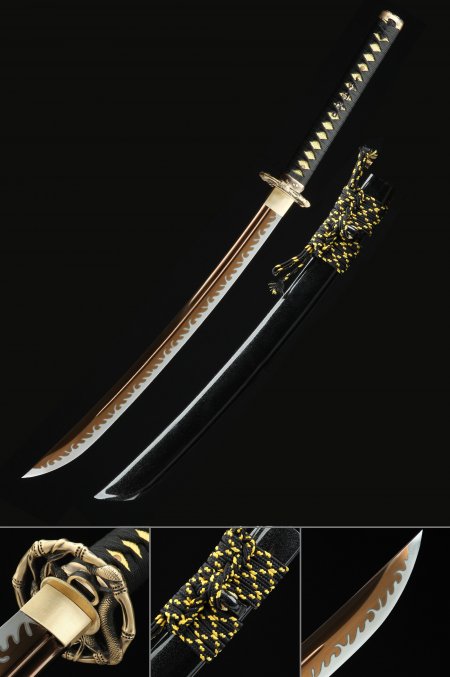
High Manganese Steel Gold Blade Wakizashi with Snake Tsuba in Black-Gold Koshirae High Manganese Steel Gold Blade Wakizashi with Snake Tsuba in Black-Gold Koshirae
Andrew Plebanski Illinois, United States

Fantastically balanced, polished, and assembled. The sword came exactly how I expected it, and functions amazingly. It is very fast, and very accurate. I have large hands and can still fit two comfortably on the handle in moments where I want to create a little extra push pull power. The quickest draw cutting blade that I have. I absolutely love this blade, and it will be with me for life. If you actually use a sword for more than wall hanging, I absolutely recommend this one.

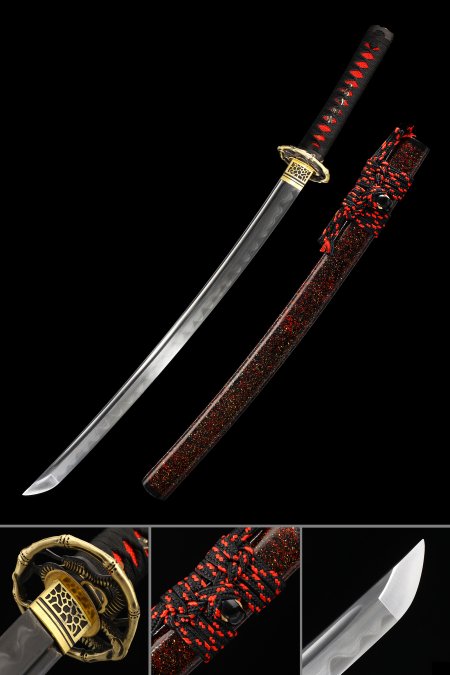
1000 Layer Folded Steel Japanese Wakizashi with Real Hamon - Red Sparkle Saya and Brass Snake Tsuba 1000 Layer Folded Steel Japanese Wakizashi with Real Hamon - Red Sparkle Saya and Brass Snake Tsuba
Cart 0 Items

Your cart is empty