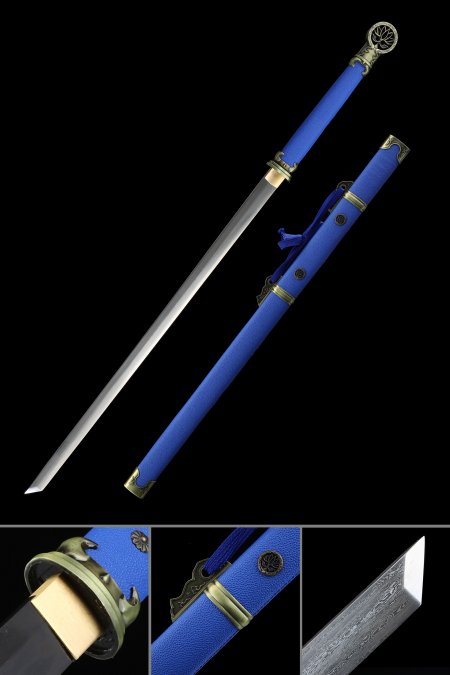
Lotus Tsuba Ninjato
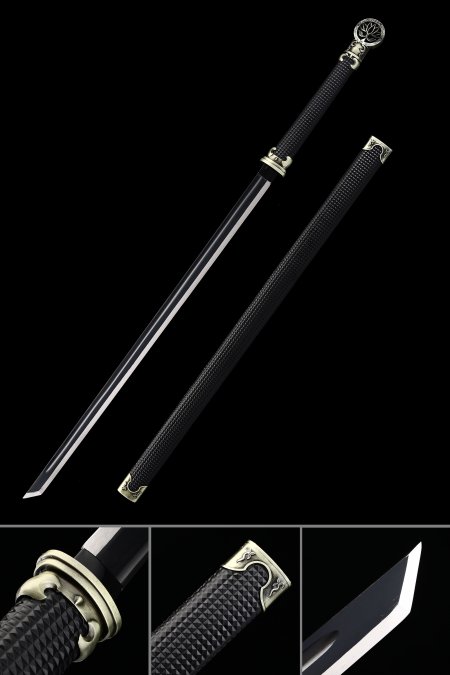
The Lotus Tsuba Ninjato collection brings together hand-assembled replicas defined by their straight-bladed silhouette, ornate bronze lotus fittings, and meticulously finished saya. Each piece pairs high-performance steel - available in layered Damascus or resilient manganese - with distinctive hardware that transforms a storied Japanese form into a refined display centerpiece. Free standard shipping is included on every order, and our hassle-free return policy ensures your collecting experience is risk-free.
Free Shipping
209.00 USD
Related Collections
Flame Blade Katana29 items
Teal Sageo Katana39 items
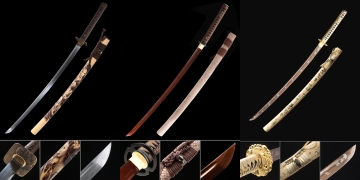
Beige Saya Katana32 items
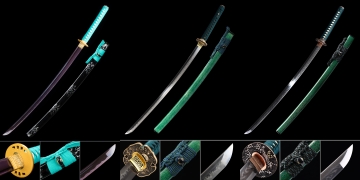
Teal Handle Katana37 items
Frequently Asked Questions
What steel types are used in Lotus Tsuba Ninjato replicas?
The Lotus Tsuba Ninjato collection is offered in two distinct steel configurations. The first uses manganese steel, an alloy known for its toughness and resistance to deformation - a practical choice for a display piece that will be handled, repositioned, or rotated in a collection over time. Its surface polishes to a consistent dark finish that pairs cleanly with the bronze lotus fittings. The second option uses Damascus steel, produced by folding and forge-welding multiple layers of steel together, which creates the flowing grain pattern visible on the blade's surface. Because the pattern emerges from the forging process itself, no two Damascus blades are visually identical, making each piece a one-of-a-kind collectible. Both variants are full-tang in construction, meaning the steel extends through the entire length of the handle, which contributes to the structural stability expected of a serious display replica.
How does a ninjato differ from a traditional katana?
The most immediately visible distinction is blade geometry: a katana features a curved blade optimized for drawing and cutting motions, while a ninjato is characterized by a straight or minimally curved blade with a squared-off profile. The ninjato also typically carries a square or round tsuba rather than the more decorative guard shapes common on katana fittings. In terms of overall length, ninjato tend to be more compact - the pieces in this collection measure 43 inches overall - compared to many full-length katana configurations. For display purposes, this difference in silhouette creates an interesting visual contrast when the two forms are mounted together, as the ninjato's angular lines read distinctly against a katana's sweeping curve. Collectors interested in representing the full breadth of Japanese sword culture often display both forms side by side to illustrate the range of historical Japanese blade design.
What do the bronze lotus fittings represent symbolically?
The lotus flower carries layered meaning across Japanese and broader East Asian cultural traditions. Most commonly, it represents purity and spiritual resilience - the image of a bloom rising untouched from muddy water became a lasting metaphor for clarity achieved through adversity. In the context of these replicas, the lotus motif is cast into the bronze tsuba and echoed in the menuki and kashira, creating a cohesive thematic narrative across all fitting points. Bronze itself is a historically significant metal in Japanese decorative arts, prized for its warm color and the natural patina it develops over time. For collectors, that patina process means the fittings will gradually deepen in tone with age, making each piece's appearance subtly evolve the longer it is displayed - a characteristic that adds to its long-term collectible appeal.
What is the best way to store and maintain a ninjato replica?
For long-term display and preservation, controlling humidity is the single most important factor. Steel - regardless of whether it is manganese or Damascus - is susceptible to surface oxidation when exposed to moisture. Maintaining your display environment at a relative humidity below 50% will significantly reduce this risk. Apply a thin coat of food-grade mineral oil or dedicated sword oil to the blade surface every two to three months, using a clean microfiber cloth to avoid fingerprint residue, which contains corrosive salts. The leather or PU leather saya should be kept away from direct sunlight to prevent fading and stiffening of the wrap material. When mounting horizontally, ensure the saya is the contact point with the stand - not the blade itself - to avoid pressure marks on the finish. Stored correctly, a well-maintained replica will retain its visual quality and structural integrity for decades.
Is the Lotus Tsuba Ninjato a good gift for a Japanese culture collector?
It is a particularly strong choice for collectors who appreciate both aesthetic cohesion and cultural specificity. The lotus motif gives the piece an immediately recognizable thematic identity that communicates cultural literacy - it signals that the gift was selected with intention rather than chosen generically. The availability of two steel types also makes it easy to match the gift to the recipient's existing collection: a collector who already displays Damascus pieces will likely appreciate the layered-grain variant, while someone with a preference for clean, uniform finishes may favor the manganese model. At 43 inches, the piece is large enough to serve as a focal point in a display arrangement without requiring an oversized mount or dedicated cabinet. The leather saya color options - black or deep blue - provide an additional layer of personalization that most comparably positioned replicas do not offer.
Customer Reviews
Mariel Tabula
Texas, United States
Delivery was fast less than two weeks! The sword if my first and am very pleased. It's 43 inches a heafty sword just right for me. Very sharp full tanged sword 🗡️ I'll be ordering another one soon Tks TrueKantana😀
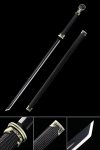 |
Manganese Steel Ninjato with Black Leather Saya - Bronze Lotus Fittings, 43 Inch Replica |