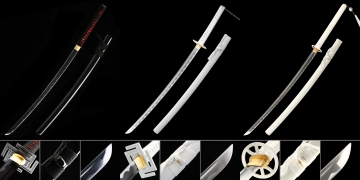
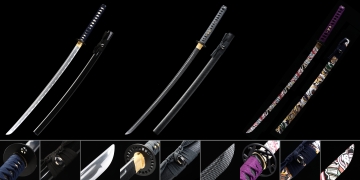
What makes a tachi different from a katana?
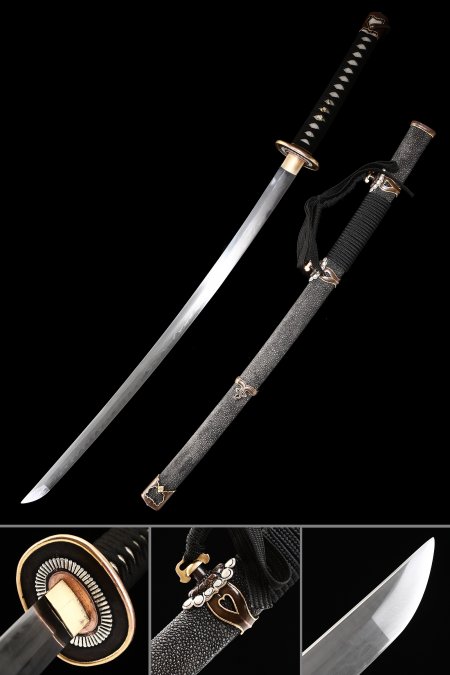
The tachi predates the katana by several centuries and differs in both geometry and carry method. Tachi blades are generally longer — often exceeding 70 cm — and feature a deeper, more pronounced curvature suited to a mounted rider drawing from horseback. They were worn suspended edge-downward from the belt, in contrast to the katana's edge-upward (buke-zukuri) carry. The signature of this carry method is often visible in the placement of the mei (maker's signature) on the tang, which faces outward when the sword is hung correctly. Collectible tachi reproduce these proportional and geometric distinctions faithfully, making them immediately distinguishable on a display stand from their katana counterparts.
What does the gray koshirae color scheme represent?
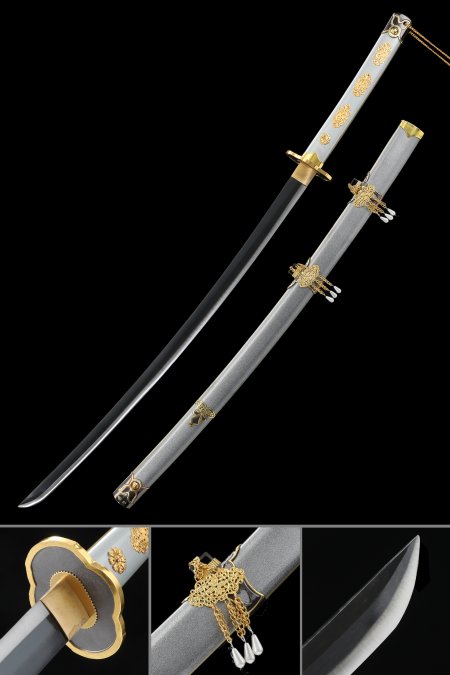
In Japanese sword fitting traditions, color choices in the koshirae — the complete mounting assembly including saya, tsuba, ito wrap, and menuki — were not arbitrary. Gray and silver tones were associated with restraint, formality, and aristocratic understatement, often appearing in court and ceremonial contexts where ostentatious decoration was considered inappropriate. A silver matte saya or gray ito wrap signals a deliberate aesthetic choice that references this historical preference for refined, subdued presentation. For modern collectors, a gray koshirae also offers practical display advantages: the neutral palette pairs well with a wide variety of interior settings without competing visually with architectural elements or other displayed pieces.
How does T10 steel differ from 1060 carbon steel for display collectibles?
Both T10 tool steel and 1060 carbon steel are high-carbon options well suited to collectible sword production, but they serve slightly different collector priorities. T10 contains a small amount of tungsten and has a higher carbon content, which contributes to its exceptionally fine grain structure and its ability to produce a sharply defined, visually dramatic hamon through differential clay tempering. Collectors drawn to the hamon as an art form — studying its activity, nie, and nioi patterns — will find T10 blades more rewarding. 1060 steel, with its slightly lower carbon content, produces a cleaner, more uniform blade surface that polishes evenly across its length, making it preferable for display contexts where surface consistency and a mirror-like finish take priority over hamon complexity.
How should a tachi be stored or displayed to prevent damage?
Long-term display of a collectible tachi requires attention to orientation, humidity, and surface protection. The blade should be lightly coated with a neutral mineral oil or traditional choji oil before storage to prevent surface oxidation, particularly if you live in a high-humidity environment. For display, horizontal mounting with the edge facing upward on a dedicated sword stand is standard practice and prevents uneven stress on the wooden saya over time. Avoid positioning the piece in direct sunlight, which can fade the lacquer finish on the saya and degrade the silk or cotton ito wrap. If storing long-term, a padded sword bag provides an additional layer of protection against dust accumulation and accidental contact.
Are gray tachi swords a good gift for Japanese sword collectors?
Gray tachi make a distinctive gift precisely because they occupy a less commonly represented category in most collections. While katana remain the default choice for introductory gifts, a tachi — with its longer blade, deeper curve, and historically earlier origins — introduces a dimension of Japanese sword history that most collectors find genuinely interesting to explore. The gray koshirae palette gives these pieces a gallery-quality visual presence that photographs exceptionally well, which matters to collectors who document their displays. For a recipient already familiar with katana, a gray tachi adds typological variety; for a newer collector, it serves as an immediate conversation piece that prompts deeper engagement with the history of Japanese edged art.