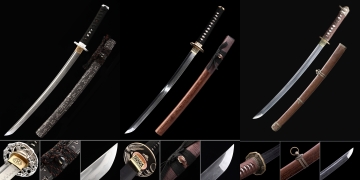
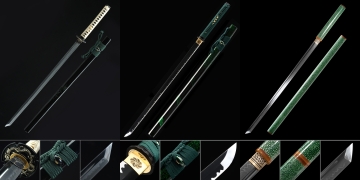
What makes dark green ito a distinctive choice for katana handles?
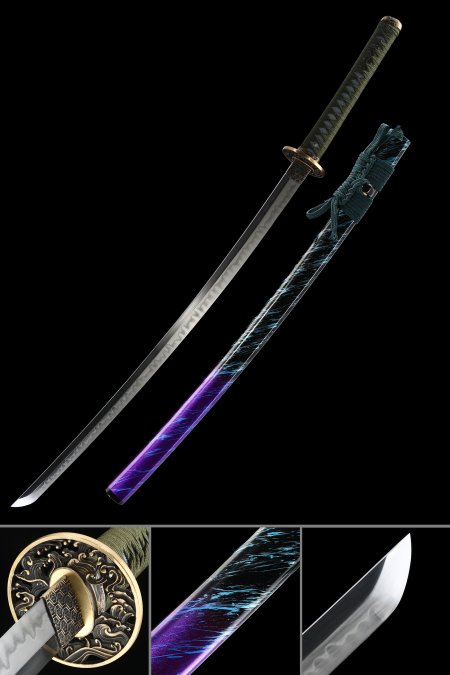
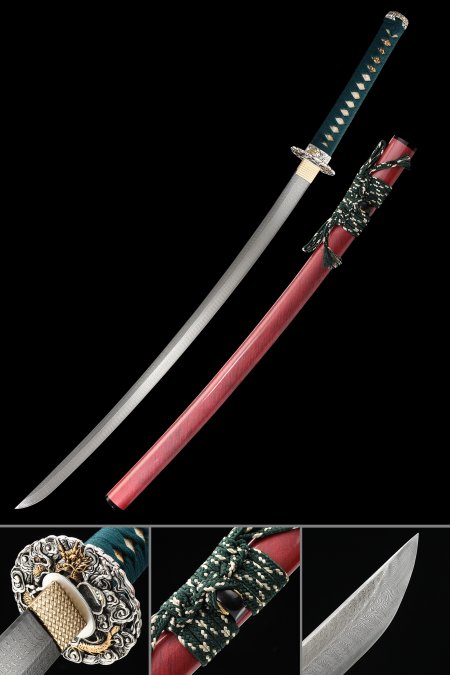
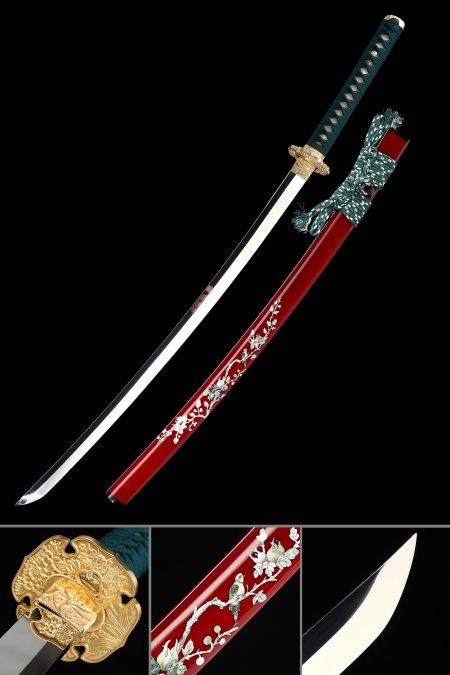
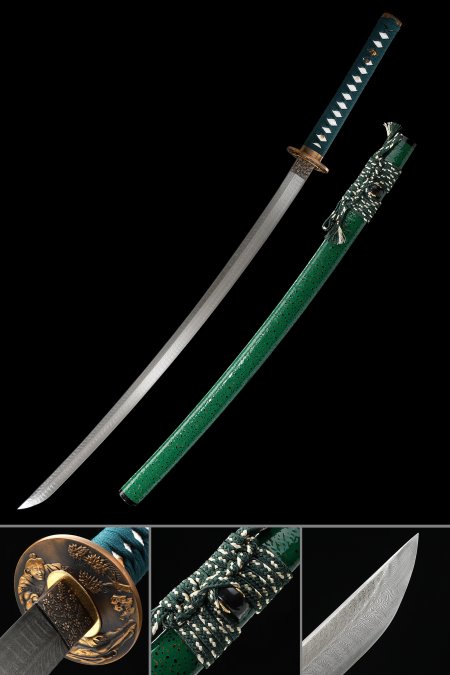
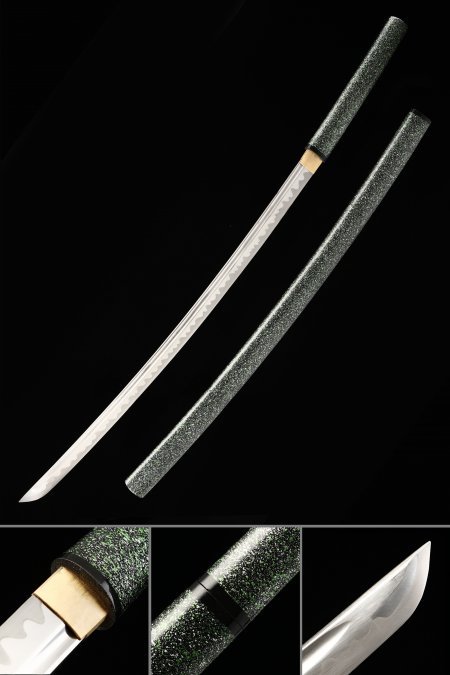
In traditional Japanese sword mountings, the ito - silk or cotton cord wrapped over same (ray skin) along the tsuka - was selected to reflect aesthetic intention and, historically, personal identity. Dark green sits at a refined intersection: muted enough to read as serious and classical, yet distinctive enough to set a piece apart from the more common black or brown wrappings. On the display stand, green ito tends to draw the eye along the handle before releasing it toward the blade, creating a natural visual flow. When matched with a lacquered saya in a complementary tone, the handle and scabbard work together as a unified composition rather than separate components - a quality that serious collectors specifically seek when curating a thematically coherent display.
How does T10 carbon steel differ from Damascus in these katanas?
T10 carbon steel is a high-carbon, tungsten-enhanced tool steel valued for its fine grain structure and its ability to produce a well-defined hamon - the visible temper line created through clay differential hardening. The hamon on a T10 blade is sharp, active, and unique to each piece, making every sword visually one-of-a-kind along the blade's edge boundary. Damascus steel, by contrast, achieves its visual character through the forge-welding of multiple steel layers, typically alternating high and low carbon alloys. The resulting grain pattern - called the Damascus pattern or ladder pattern depending on the twist technique - appears across the flat of the blade rather than at the edge. Both materials offer compelling display aesthetics, but they tell different stories: T10 speaks to classical Japanese differential hardening traditions, while Damascus speaks to a layered forging heritage with deep visual complexity.
Why does full-tang construction matter for a display katana?
Full-tang construction means the steel of the blade extends in a single continuous piece through the entire length of the tsuka, secured by mekugi pins passing through the tsuka-gashira and tsuka itself. In a display context, this matters for two reasons. First, it reflects the actual construction standard of historically significant Japanese swords, making the piece a more authentic representation of the craft. Second, it ensures the sword can be safely handled during display changes, photography sessions, or when showing the piece to other collectors - the handle will not shift or loosen over time the way rat-tail or partial-tang constructions can. For collectors who value longevity and structural honesty in their pieces, full-tang is the baseline expectation, not an upgrade.
How should I maintain the lacquered saya on a green handle katana?
Lacquered sayas require more attentive care than plain wood or synthetic scabbards. Avoid prolonged exposure to direct sunlight, which can cause the lacquer to fade or crack over time. High humidity is equally problematic - moisture can cause the wooden core to swell, making blade removal stiff and potentially stressing the lacquer surface. Store your katana horizontally or at a gentle angle in a climate-controlled room, and handle the saya with clean, dry hands to prevent oils from dulling the finish. The blade itself should be lightly oiled with dedicated sword oil every few months; use a soft cloth to apply a thin coat and remove excess, which prevents rust on the carbon steel while keeping the habaki and blade-to-saya fit smooth. Never force a blade in or out of a tight saya - if fit becomes stiff, allow humidity levels to stabilize before attempting removal.
Are dark green handle katanas a good choice as a collector's gift?
For a recipient who already appreciates Japanese sword craft or decorative edged collectibles, a dark green handle katana is a genuinely considered gift. The color makes the piece immediately distinctive among typical display swords, and the matching saya-and-ito aesthetic signals that care went into the selection. When choosing for someone else, prioritize pieces with named steel types - T10 or Damascus - over generic stainless, as these carry more credibility in collector circles and age more gracefully on display. Pairing the sword with a quality maintenance kit adds practical value and shows awareness of what ownership actually involves. Presentation boxes or sword bags, often included with pieces in this collection, complete the gifting experience without requiring additional packaging effort.