What defines a hamidashi compared to a standard tanto?
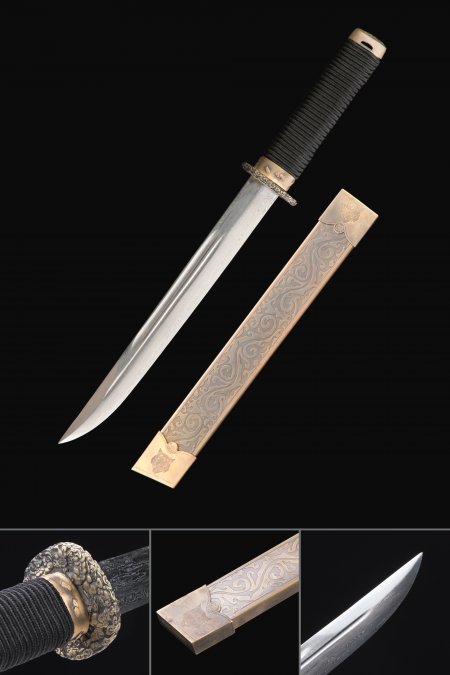
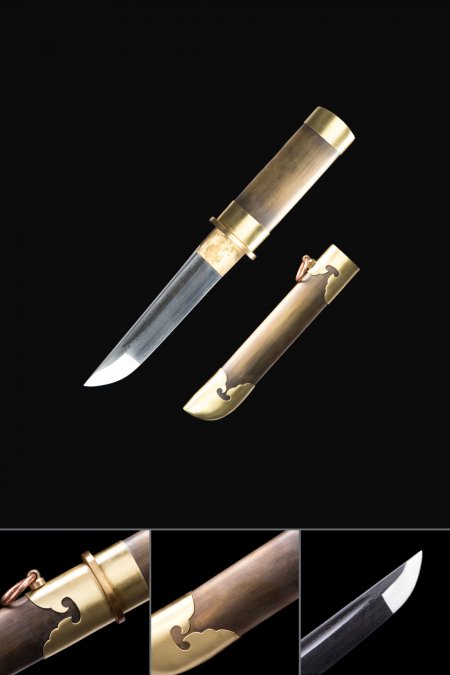
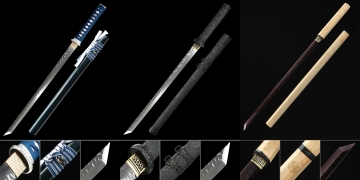
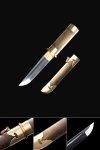
A hamidashi is distinguished primarily by its ko-tsuba — a guard so small it barely clears the edge of the handle, in contrast to the more prominent tsuba found on a full tanto. This minimal guard gives the hamidashi a cleaner, more continuous profile from handle to blade. The blade geometry itself is typically identical to a tanto — a straight or very slightly curved single-edged form with a reinforced point — but the fittings architecture is what classifies it. For collectors, this distinction matters because the ko-tsuba format highlights the quality of the handle wrap and habaki more directly than a larger guard would, making every fitting choice more visible.
How is the Damascus pattern formed on these blades?
The pattern on these blades is produced through a process called pattern welding, where multiple steel billets with differing carbon content are stacked, heated, and hammered together repeatedly. Each folding cycle doubles the number of layers while distributing carbon throughout the billet. The smith can further manipulate the surface pattern by twisting, grinding channels into, or otherwise reshaping the billet before the final forging pass. Once the blade is shaped and heat-treated, an acid solution is applied to the polished surface — the acid reacts differently with high and low carbon areas, etching the lower carbon regions darker and making the layered grain fully visible. Because the pattern develops from physical manipulation rather than a template, every blade produces a unique surface design.
Why are bronze and copper fittings paired with Damascus blades?
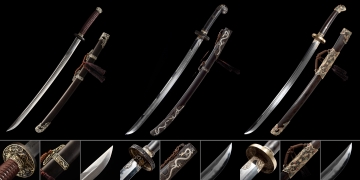
The pairing is both aesthetic and historically grounded. Bronze and copper-tone metals — including shakudo and sentoku alloys in traditional Japanese work — were widely used for tsuba, fuchi, and kashira because their warm amber and reddish hues create visual contrast against polished steel. On a Damascus blade, where the surface already carries significant visual complexity from its layered pattern, bronze fittings provide a tonal anchor that frames the blade without competing with it. From a collector’s standpoint, the oxidization behavior of bronze over time also adds to display appeal — the fittings develop a natural patina that deepens the overall character of the piece rather than degrading it.
How should I store and maintain a Damascus display piece?
The acid-etched surface of a Damascus blade is more susceptible to moisture and fingerprint oils than a plain polished blade, because the etching creates microscopic surface relief that traps contaminants. For display storage, keep the piece in a low-humidity environment and apply a thin coat of blade oil — choji oil or a mineral-based alternative — every few months using a soft cloth. When handling, use cotton gloves or wipe down the blade after contact. If the blade is stored inside a wooden saya for extended periods, ensure the interior is dry before sheathing, as trapped moisture can cause surface oxidation along the etched areas. Bronze and copper fittings benefit from occasional light polishing with a non-abrasive cloth to preserve their finish.
Does a compact hamidashi work well as a display gift for collectors?
The hamidashi format is particularly well-suited as a collectible gift precisely because of its scale. It presents the full vocabulary of Japanese blade craft — patterned steel, fitted guard, wrapped handle, finished saya — in a compact form that displays comfortably on a desk stand, in a shadow box, or within a curated case without requiring the dedicated wall space a longer piece demands. For a recipient who already collects Japanese-style blades, a bronze-fitted Damascus hamidashi offers a meaningful contrast piece due to its unique guard style. For someone new to the category, it serves as an accessible entry point that doesn’t overwhelm a display but still carries genuine material and craft value.