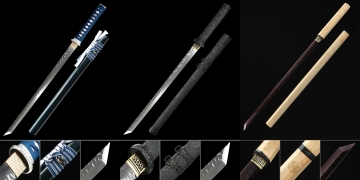
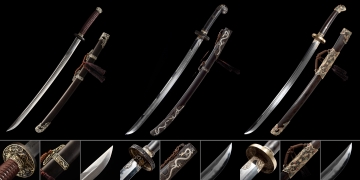
What makes Damascus steel visually distinct on a naginata blade?
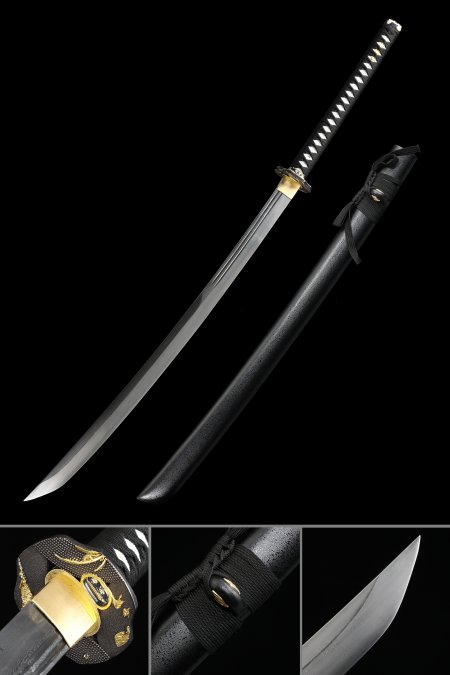
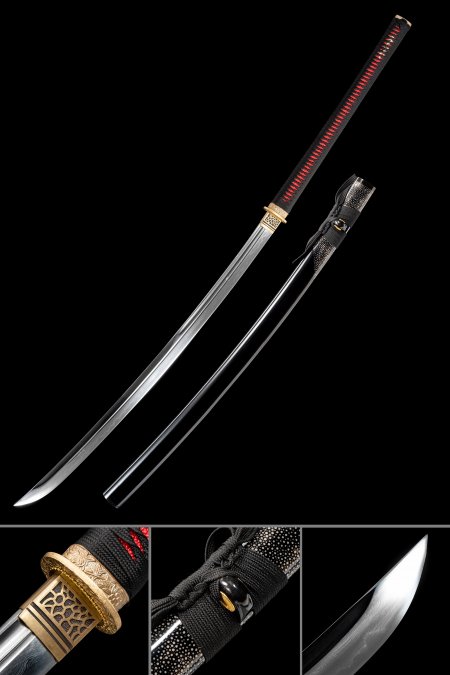
Damascus, or pattern-welded, steel is produced by forge-welding multiple layers of steel with differing carbon content, then folding and drawing the billet repeatedly. As the smith works the steel, the two alloys intermix into flowing, organic lines that become visible after etching and polishing. On a naginata blade — which is longer and more gently curved than a katana — this grain pattern has more surface area to develop across, creating a visual rhythm that travels the full length of the blade. Because the pattern emerges from the physical structure of the steel rather than from surface treatment, it cannot wear off or be replicated by acid etching alone. Each billet produces a genuinely unique pattern, which is a central part of the collectible appeal.
What is a real hamon, and how is it formed on these blades?
A hamon is the visible temper line that forms along a blade after clay differential tempering. During this process, the smith applies a layer of clay to the spine of the blade before quenching, which causes the spine to cool more slowly and remain relatively soft and flexible. The edge, exposed directly to the quench, hardens into a high-carbon crystalline structure called martensite. The boundary between these two zones becomes visible after polishing as a misty, undulating line — the hamon. On the Damascus Steel Naginata pieces in this collection, the hamon is the result of this authentic heat-treatment process, not acid etching or mechanical engraving. It is a permanent feature embedded in the steel's metallurgical structure.
How does a naginata differ from other Japanese bladed polearms?
The naginata is defined by its long wooden or wrapped shaft paired with a single-edged, curved blade mounted via a tang and secured with a collar called a habaki. Unlike the yari, which carries a straight symmetrical spear point, the naginata's blade has a pronounced curve and a distinct cutting edge, making it closer in profile to a mounted katana blade. The nagamaki, another related form, features a longer handle relative to its blade and was typically associated with mounted use. The naginata's proportions — generally emphasizing a longer shaft and a moderately sized blade — give it a distinctive silhouette that has made it a recognizable and sought-after form for Japanese arms collectors.
How should I store and maintain a black lacquer saya long-term?
Black lacquer saya require specific care to preserve their finish. Store the naginata horizontally on a padded rack rather than standing vertically, which can stress the lacquer at the koiguchi over time. Keep the storage environment at stable humidity — ideally between 45% and 55% relative humidity — because lacquer is prone to cracking in very dry conditions and can develop cloudiness in excess moisture. Avoid prolonged exposure to direct sunlight, which causes the lacquer surface to fade and become brittle. When cleaning, use only a soft, dry cloth; solvents and alcohol will strip the finish. The blade itself should be lightly coated with a neutral, non-acidic oil such as choji oil every few months to prevent surface oxidation.
Is a Black Damascus Steel Naginata a good centrepiece for a Japanese arms display?
Because of its length and distinctive silhouette, a naginata functions exceptionally well as a focal point in a Japanese arms display. The polearm format naturally draws the eye across an entire wall section rather than concentrating attention on a single small object. Pairing a Black Damascus Steel Naginata with complementary pieces — such as a matching Damascus katana or a tanto in similar fittings — creates visual cohesion through shared materials and finish tones. Dedicated horizontal wall mounts or floor stands designed for long-hafted pieces are widely available and allow the full length of the naginata to be appreciated. The combination of the layered blade surface and the deep black lacquer saya makes for a display that holds interest under both ambient and directed accent lighting.