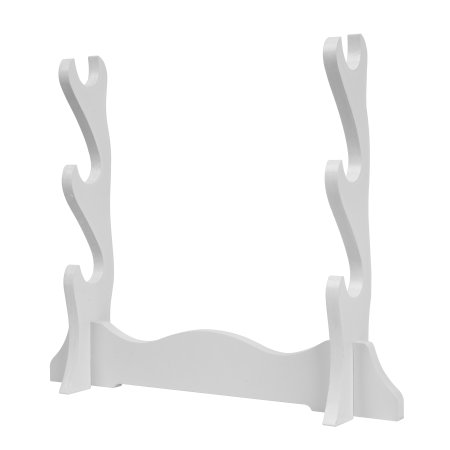
White Swords Stand
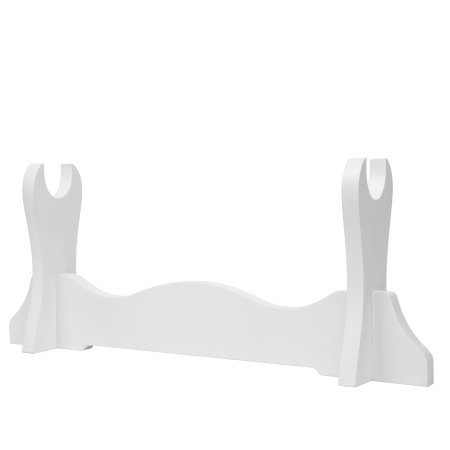
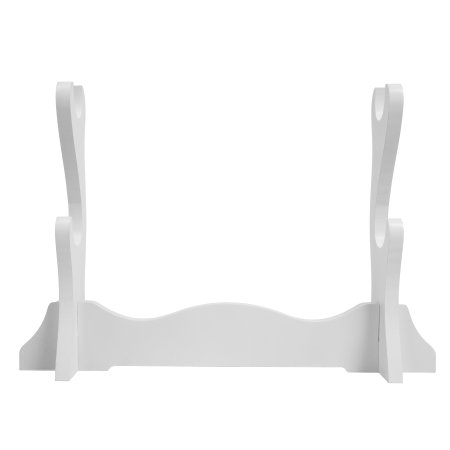
A clean, gallery-worthy display begins with the right foundation. Our white sword stands are handcrafted from solid wood and finished in a crisp, neutral white that complements any blade - from a sleek shirasaya to a richly mounted tachi. Available in single-, double-, and triple-tier configurations, each stand is built to cradle your katana securely while keeping the focus entirely on the piece itself. Every order ships free with hassle-free returns, so curating your display space is completely risk-free.
Related Collections
Frequently Asked Questions
What wood is used in these white sword stands?
Each stand in this collection is constructed from solid wood rather than engineered composites like MDF or particleboard. Solid timber offers superior weight-bearing stability, which matters when a fully mounted katana — tsuka, saya, and all fittings — rests on the cradle arms for extended periods. The white finish is applied over the natural wood grain, resulting in a smooth, consistent surface that holds color evenly and resists yellowing under standard indoor lighting conditions. This construction method also means the joints maintain their integrity over time, so the stand remains level and stable even after years on a shelf or display cabinet.
Will the cradle arms scratch or mark my saya?
The cradle arms on these stands are shaped and angled specifically to cradle a saya along its flat or slightly curved lower surface, distributing weight across a broader contact area rather than concentrating it on a single edge. The finished wood surface is smooth enough to avoid abrasion on lacquered or natural wood sayas under normal display conditions. If you are displaying a particularly high-value or delicate saya finish — such as a fine roiro or nashiji lacquer — collectors often add a thin felt or microfiber buffer strip to the cradle contact points as an additional precaution. This is standard practice for high-end display and adds minimal visual interference.
How do single, double, and triple-tier stands differ in use?
The tier count determines both display capacity and the visual story a stand tells. A single-tier stand isolates one piece completely, making it ideal for a primary collection centerpiece or a blade in exceptional mounts where shared visual space would dilute its presence. A double-tier stand enables pairing — most classically a katana and wakizashi arranged as a daisho set, which was the traditional matched pair worn by samurai and remains one of the most recognized presentation formats in Japanese sword collecting. The three-tier stand supports a fuller grouping, allowing a tanto, wakizashi, and katana to be displayed together as a coherent set, or three thematically linked pieces to be organized into a single focal display rather than scattered across separate stands.
Does a white finish suit all blade and mounting styles?
White is one of the most versatile neutral finishes available for sword display precisely because it does not carry the warm undertone of natural wood or the cool-industrial feel of black lacquer. Against a white cradle, both dark and pale saya colors read clearly: a deep black roiro lacquer appears sharper, a natural wood saya shows its grain texture more distinctly, and a polished tsuka wrapped in white or cream ito retains its visual separation from the stand. White also performs well in mixed-lighting environments — it does not shift toward orange under warm bulbs the way raw wood can. For wall display backgrounds that are white or off-white, the stand effectively becomes part of the neutral field, letting the blade itself carry all the visual weight.
Are these stands suitable as gifts for sword collectors?
A display stand is one of the more practical and universally appreciated gifts in the collecting space, because almost every collector eventually needs more of them. The white finish has broad appeal across different decorating styles — it reads as contemporary in a minimalist room and as clean and traditional in a more formal display setting. The handmade solid wood construction signals genuine quality rather than a mass-produced prop, which matters to collectors who are attentive to craft. For gift-giving, the three-tier option is particularly well received because it gives the recipient immediate flexibility — they can display one blade, two, or three, and the stand grows with the collection rather than becoming obsolete.