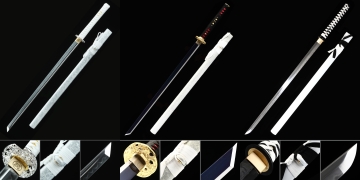
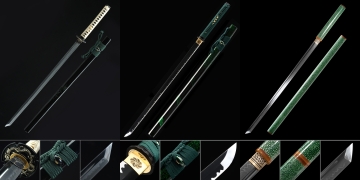
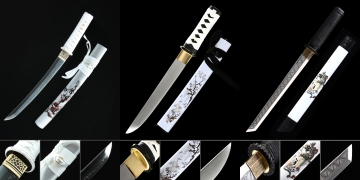
What makes a white or green saya special for display?
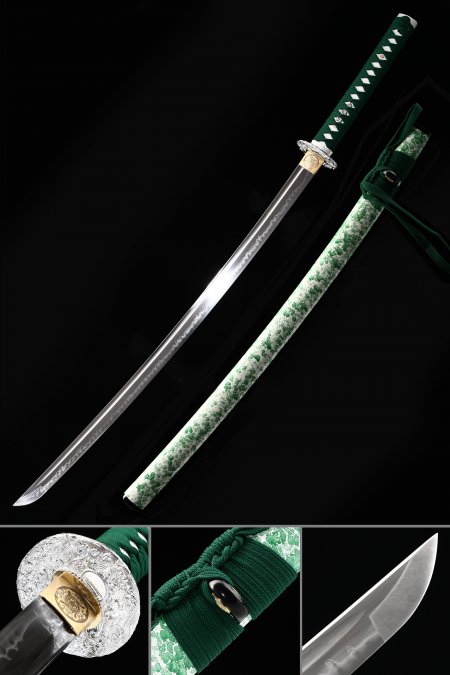
Colored and patterned sayas have roots in Japanese court and ceremonial sword traditions, where the scabbard signaled rank and taste as much as the blade itself. White lacquer saya were associated with formal presentation pieces, while green tones appeared in both military and artistic koshirae across different periods. For display purposes, these finishes create strong visual contrast against dark wood stands or wall-mounted racks, making the full sword composition readable from a distance. Unlike raw wood or plain black lacquer, a painted or marbled saya invites examination at close range as well, functioning as a miniature artwork in its own right.
How does T10 clay tempered steel differ from manganese steel?
T10 is a high-carbon tool steel with a tungsten additive that improves wear resistance and edge retention. When clay tempered, the differential cooling between the coated spine and the exposed edge produces a visible hamon — the wavy temper line that collectors and nihonto enthusiasts specifically look for as a mark of traditional craftsmanship. Manganese steel, by contrast, achieves its hardness through manganese content rather than carbon alone, and does not develop a hamon through standard clay tempering. It tends to show a darker, more uniform surface. Both are legitimate choices for collectible katana, but they represent different metallurgical traditions and produce distinctly different visual characters on the polished blade.
How should I care for a lacquered saya long-term?
Lacquered sayas are more resilient than they appear but respond poorly to two things: prolonged UV exposure and sudden humidity changes. Direct sunlight can fade or shift colored lacquer finishes within a few months of continuous exposure, so display positioning away from windows is advisable. Extreme humidity swings can cause the wood core beneath the lacquer to expand and contract, eventually leading to surface micro-cracking. Storing or displaying in a stable indoor environment between 40–60% relative humidity is ideal. For cleaning, a soft dry cloth is sufficient — avoid solvent-based cleaners on the saya surface entirely, as they can strip lacquer coats. The blade itself should receive a light coat of choji or mineral oil every few months to prevent oxidation.
Is a dragon-painted saya considered authentic to Japanese tradition?
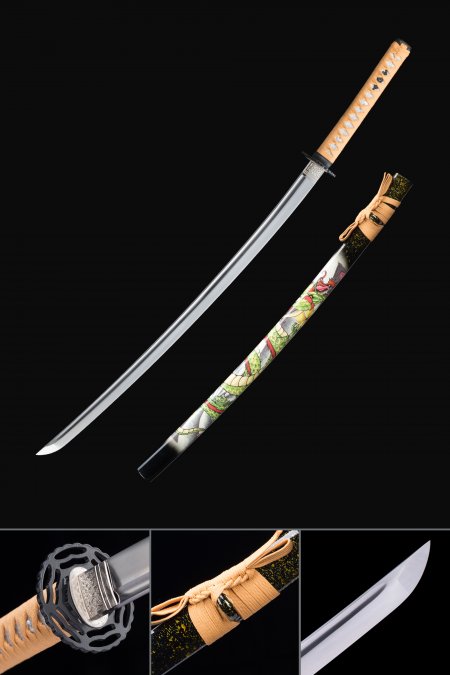
Dragon imagery has deep roots in Japanese sword furniture going back to the Muromachi period, appearing on tsuba, menuki, kashira, and saya alike. Hand-painted saya with dragon motifs were produced for ceremonial and presentation swords, particularly those intended as gifts between daimyo or offered at shrines. The specific style varied by region and period — some featured ink-wash painted dragons under clear lacquer, others used raised lacquer (taka-maki-e) to add dimensionality. Modern nihonto replicas using this motif are drawing on a genuine historical decorative tradition, making them meaningful collectibles for anyone interested in Japanese decorative arts as well as blade craft.
Can these katana be displayed without a dedicated sword stand?
A dedicated stand is strongly recommended, both for presentation quality and for protecting the saya finish. Without a stand, a katana laid flat on a shelf can develop contact marks on the lacquer surface, particularly at pressure points near the koiguchi (scabbard mouth) and the kojiri (end cap). Horizontal two-peg stands are the most traditional format and allow the full saya length to be appreciated as a visual element. Vertical floor stands work well for single-piece display in larger rooms. Wall-mounted horizontal brackets are a popular option for collectors with multiple pieces, as they elevate the saya above contact surfaces entirely and make the color and pattern of a white or green finish the focal point of the display.