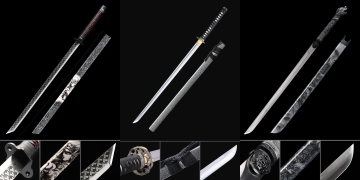
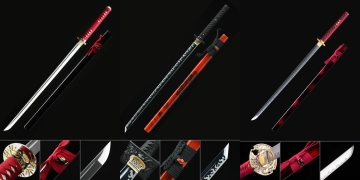
What makes silver handle katana stand out as collectibles?
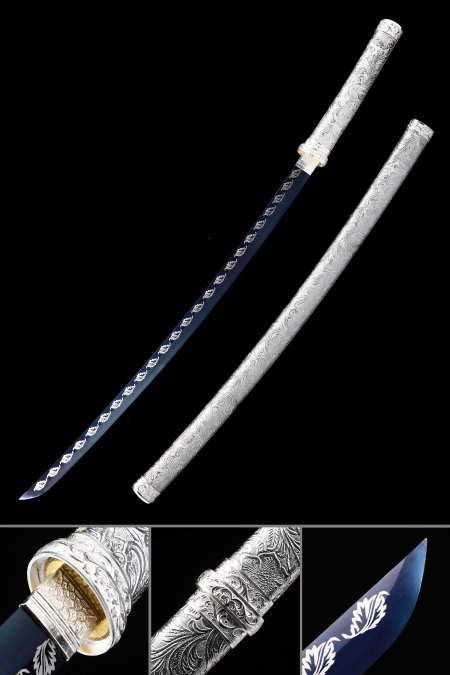
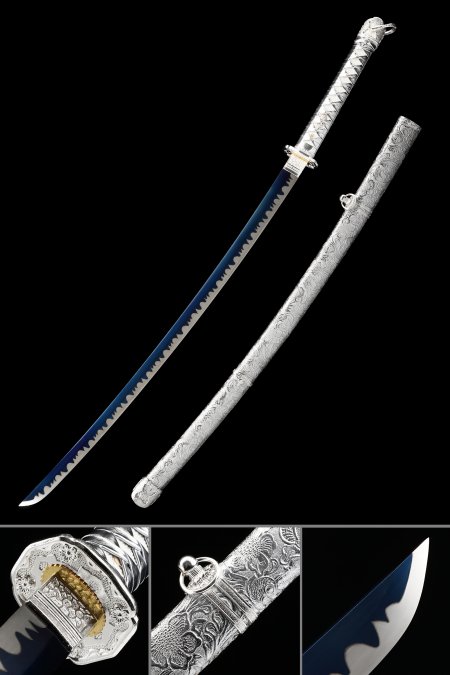
Silver handle katana distinguish themselves through the density of hand-engraved metalwork on their fittings — fuchi, kashira, menuki, and tsuba — which transforms functional hardware into miniature sculptural art. Unlike plain tsuka wrapped in ito cord alone, silver-toned koshirae pieces are often individually cast or cut and then engraved with motifs drawn from Japanese heraldry, nature, and court aesthetics. For a collector, this means each fitting can be studied independently as a craft object. The engraved saya adds another layer: lacquered scabbards with incised silver designs reference a decorative tradition used on high-ranking military and ceremonial swords, giving display pieces genuine historical reference points beyond their visual appeal.
How does manganese steel differ from high carbon steel in a katana?
Manganese steel contains a higher proportion of manganese as an alloying element, which increases toughness and surface hardness compared to plain carbon steel. In collectible katana, this translates to a blade that holds its shape well under display conditions and develops a visually appealing grain structure when polished or given a blue oxidized finish. High carbon steel — typically 1045, 1060, or 1095 grades — achieves its properties primarily through carbon content and heat treatment, producing a sharper hamon line and a more traditional appearance favored by purists. Manganese steel blades tend to have a slightly more uniform surface sheen, which complements decorative blue finishes particularly well, making them a practical choice for visually driven collector pieces.
What is the historical context of the Type 98 Shin Gunto design?
The Type 98 Shin Gunto was introduced by the Imperial Japanese Army in 1938 as a standardized officer's sword that retained the external form of classical tachi and katana while adapting manufacturing to wartime production needs. Its distinctive features include a traditionally wrapped tsuka, a cherry blossom or chrysanthemum motif tsuba, and a metal saya — often field gray or brown — rather than the lacquered wood scabbard of earlier periods. Collector reproductions inspired by this pattern, particularly those with engraved silver saya and chrysanthemum tsuba, capture the ceremonial and aesthetic dimensions of the design while functioning as display pieces. For collectors interested in 20th-century Japanese military history, Type 98-style katana offer a tangible connection to a pivotal and heavily documented period of sword design.
How should I care for the silver-toned fittings on a display katana?
Silver-toned metal fittings on a collectible katana require minimal but consistent care to maintain their engraved detail and surface finish. Avoid touching the fittings with bare hands during handling, as skin oils accelerate tarnishing in the recesses of engraved lines. For routine cleaning, a soft lint-free cloth is sufficient to remove dust. If tarnish develops, a non-abrasive silver polishing cloth applied with light pressure along the flat surfaces — not scrubbing across engraved grooves — will restore luster without damaging detail work. Keep the piece away from coastal or high-humidity environments, and consider a display case with a small silica gel desiccant pack to manage ambient moisture. The blade itself should receive a light application of choji or mineral oil on exposed steel surfaces every six to twelve months.
Are silver handle katana a good choice as a display gift?
Silver handle katana are among the more gift-appropriate options in Japanese sword collecting because their visual impact is immediate — the contrast between an engraved silver saya, ornate fittings, and a distinctively finished blade reads clearly even to someone unfamiliar with katana collecting. They work well mounted on a horizontal stand on a desk or bookshelf, or displayed vertically on a wall mount in a study or living room. For recipients with an interest in Japanese history, military history, or decorative metalwork, the layered craft references give the piece lasting conversational and intellectual appeal beyond its decorative function. Pairing a silver handle katana with a quality display stand completes the presentation and signals that the piece is intended as a collectible to be displayed with care.