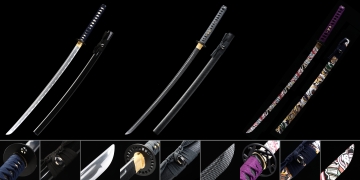
What steel is used in the Rurouni Kenshin Tanto?
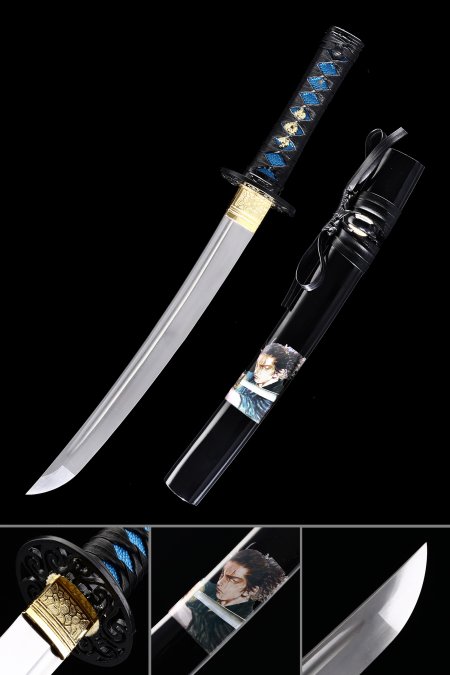
The blade is crafted from manganese steel, a medium-carbon alloy that balances hardness with workability - making it well-suited for display-grade collectibles that need to hold a clean, polished edge over time. Manganese steel is harder than mild decorative steel but more forgiving to finish than high-carbon tool steels, which is why it appears frequently in quality anime collectible blades. The tanto profile itself - with its angular, chisel-like tip - is ground to reflect the classic Japanese short-blade geometry that defined the form during the Kamakura and Edo periods.
What does samegawa mean on a tanto handle?
Samegawa (鮫皮) literally translates to "ray skin" - specifically the hide of a stingray, which was used by Japanese sword fittings craftsmen from at least the Muromachi period onward. The material's naturally granular surface, formed by small calcified nodules called pearl spots, creates a visually distinctive texture and provides an excellent base for the ito (cord) wrap applied over it. On the Rurouni Kenshin Tanto, the samegawa is presented in blue, a color choice that directly references the anime's visual identity while remaining consistent with historical precedent - colored samegawa was indeed used on period pieces, particularly for ceremonial or court-presented swords.
How should I store and maintain this display tanto?
For long-term display, keep the tanto in its saya (scabbard) and store it horizontally or at a slight downward angle - blade edge facing upward - to prevent oil from pooling at the tip. Apply a light coat of choji oil or mineral oil to the blade every few months using a soft cloth, and avoid storing the piece in areas with high humidity or direct sunlight, both of which can accelerate oxidation on the steel and fade the lacquer finish on the saya. Never use chemical cleaners on the lacquered saya surface; a dry or very slightly damp cloth is sufficient for dusting. If the piece is displayed openly rather than in a case, monthly maintenance checks are advisable.
Is this tanto a good gift for a Rurouni Kenshin fan?
It makes an exceptionally thoughtful gift for fans who have moved beyond posters and figurines and want something with tangible craft value. The combination of anime-print saya detailing and authentic construction elements - manganese steel blade, lacquered hardwood scabbard, samegawa handle - gives it credibility as both a fandom collectible and a display piece that works in any setting. It suits fans aged 18 and older and pairs naturally with a wall-mounted display stand or a dedicated collector's shelf. If the recipient is new to Japanese blade collecting, a brief care card explaining the basics of oiling and storage adds a welcome personal touch.
How does a tanto differ from a katana or wakizashi?
Blade length is the primary distinction in traditional Japanese classification. A tanto measures under one shaku (approximately 30 cm / 12 inches), making it the shortest of the three main blade forms. A wakizashi falls between one and two shaku, while a katana exceeds two shaku. Beyond length, the tanto's blade geometry is notably different: it typically uses a flat (hira) or single-bevel grind with an angular, reinforced tip - the latter designed to maintain structural integrity at a shorter overall length. Historically, tanto were carried as companions to longer blades, often by samurai as a secondary piece or by court officials who were not permitted to carry longer arms.