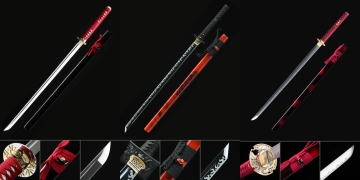
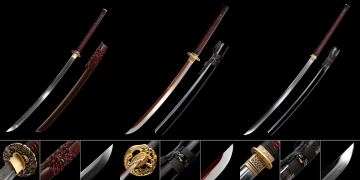
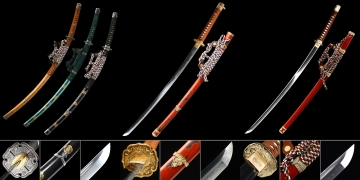
What does the red ito wrapping on a wakizashi represent?
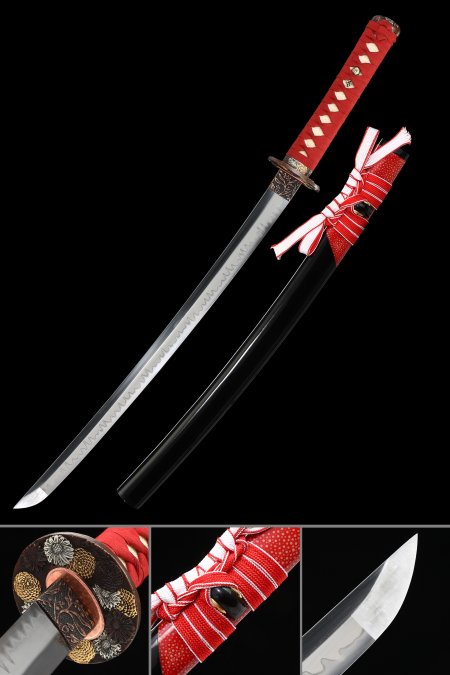
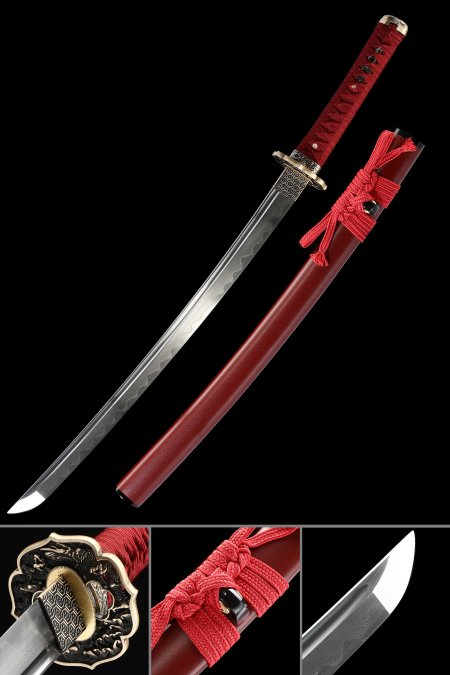
In historical Japanese sword culture, red lacquer and red cord wrappings were associated with high-ranking samurai, ceremonial presentation, and marks of distinction within feudal households. The ito itself — cord wrapped in a tight, diamond-pattern weave over same (ray skin) — serves both a functional grip role and a deeply aesthetic one. On a display-grade collectible, the crimson ito is typically made from durable synthetic or silk-style cord that maintains its color and texture over years of display without fading, making it an excellent choice for collectors who prioritize long-term visual presentation alongside historical symbolism.
How does T10 steel differ from Damascus steel in a wakizashi blade?
T10 manganese steel is a high-carbon tool steel valued for its fine grain structure and the striking hamon — the undulating temper line — produced by the clay-temper differential hardening process. Each hamon is unique to the individual blade, giving T10 wakizashi a one-of-a-kind character that collectors specifically seek. Damascus steel, by contrast, is created by forge-welding and folding multiple steel layers together, producing the flowing, contrasting surface patterns visible across the entire blade. Where T10 showcases the art of heat treatment, Damascus showcases the art of pattern-welding. Both are highly regarded in collecting circles, though they appeal to somewhat different aesthetic preferences.
How should I store a red handle wakizashi to preserve the ito?
Store your wakizashi horizontally in a padded display case or on a proper sword stand, away from direct sunlight, which can fade red ito over time regardless of material. Humidity is the primary enemy of both the handle components and the lacquered saya — aim for a stable indoor environment between 40–60% relative humidity. Apply a light coat of choji or mineral oil to the blade every few months to prevent surface oxidation, and avoid touching the blade surface with bare hands, as skin oils accelerate patina formation. The saya should be removed periodically to ensure no moisture is trapped against the blade.
Can a red handle wakizashi be paired with a matching katana for display?
Yes — and this is one of the most popular display approaches among Japanese sword collectors. In feudal Japan, a samurai carried both a katana (long sword) and a wakizashi (short sword) together as a daisho, a paired set that signified samurai status. Recreating this pairing with matching red ito handles, complementary tsuba designs, and coordinating saya lacquer creates a cohesive wall or case display with strong visual and historical narrative. A matching red handle katana mounted above the wakizashi on a dual-tier stand is a classic configuration that works exceptionally well in both modern and traditionally styled interiors.
What makes a wakizashi a good starting point for new collectors?
Wakizashi occupy an ideal middle ground for collectors entering the Japanese sword space. Their shorter blade length — typically 30–60 cm — makes them easier to display, transport, and store compared to a full-length katana, while still representing all the key elements of traditional Japanese sword construction: hand-forged blade, authentic tsuba fittings, ito-wrapped handle, and lacquered wooden saya. The lower footprint also means display stands and cases are more affordable and widely available. A visually distinctive piece like a red handle wakizashi also makes an excellent conversation-starting centerpiece for a new collection before expanding into larger or more specialized pieces.