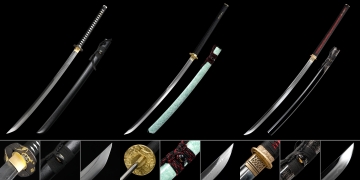
What defines a tachi compared to a katana?
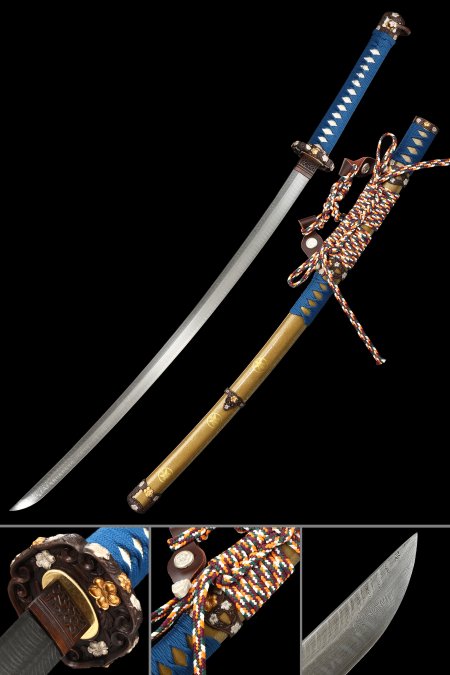
The tachi predates the katana by several centuries and differs in three measurable ways. First, its nagasa (blade length) typically exceeds 70 cm, making it noticeably longer than a standard katana. Second, its sori (curvature) is deeper and positioned closer to the base of the blade rather than the center, giving it a more pronounced arc when viewed in profile. Third, and most visually striking for display purposes, the tachi was worn suspended edge-downward from the belt — the opposite of the katana's thrust-through-obi carry. This edge-down orientation is the historically correct way to display a tachi on a stand, and it changes the entire visual balance of the piece compared to how a katana would be presented.
How is olive Damascus steel different from standard Damascus?
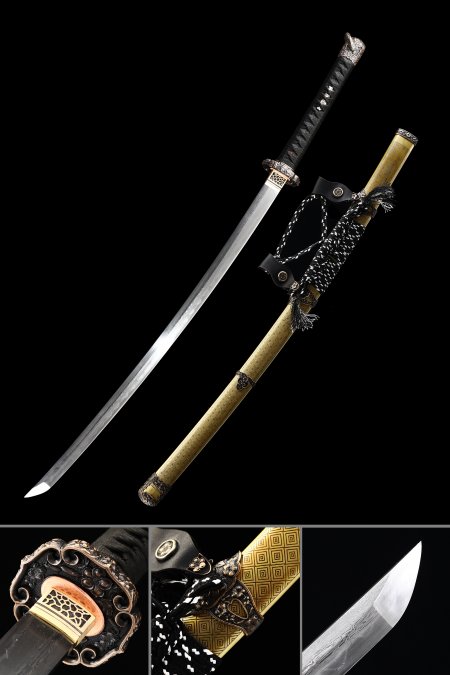
The term 'olive Damascus' refers to the surface color tone produced when specific steel alloy combinations are etched to reveal the layered pattern. Standard Damascus billets etched with ferric chloride tend to produce high-contrast dark-and-silver patterns. Olive Damascus uses steel pairings and controlled etch times that yield warmer, greenish-brown mid-tones alongside the bright layer lines — an effect that complements gold lacquer fittings and bronze hardware particularly well. The underlying metallurgical process is the same: repeated folding, welding, and drawing out of dissimilar steel layers, which creates the flowing grain visible on the finished blade. No two billets produce identical patterns, which is a core part of the collectible appeal.
What is a real hamon and why does it matter for collectors?
A hamon is the visible boundary line between the hardened edge zone and the softer spine of a blade, created through differential heat treatment — the edge is coated in clay before quenching, so it cools faster and hardens, while the spine cools slowly and remains tough. On collectible display blades, a real hamon produced this way shows a natural, irregular activity line with nie (bright crystalline granules) and nioi (misty transition zones) that an acid-etched fake hamon cannot replicate. Under raking light, a genuine hamon shifts and shimmers as the blade is rotated. For collectors studying nihonto craft traditions, the presence of an authentic hamon is a meaningful marker of the blade-maker's process, not merely a cosmetic detail.
How should I care for a Damascus tachi kept on display?
Damascus patterned blades require consistent but minimal care to maintain their appearance. Every three to four months, apply a small amount of choji oil (or a food-grade mineral oil substitute) using a soft, lint-free cloth, spreading it in thin strokes along the flat and shinogi-ji. Buff lightly so no excess pools in the hamon area. Keep the blade in its saya when not being examined — the lacquered wood regulates minor humidity fluctuations. Avoid displaying near heating vents, windows with direct sunlight, or coastal environments with salt air, all of which accelerate surface oxidation. If the olive Damascus pattern begins to look dull or flat, a single careful re-etch by an experienced bladesmith can restore contrast without harming the blade geometry.
Is a Damascus tachi a good centerpiece gift for a serious collector?
A Damascus tachi works particularly well as a high-impact display gift because its length and curvature make it visually dominant on any wall mount or floor stand — it simply commands more presence than a shorter blade. For a collector who already owns katana or wakizashi pieces, a tachi introduces a different historical period and blade silhouette that complements rather than duplicates what they likely have. The olive Damascus finish with gold lacquer saya and ornate bronze or alloy tsuba fittings reads as considered and specific rather than generic, signaling that the giver understood the recipient's interest in craft detail. Pair it with a dedicated tachi stand that holds the blade edge-downward for a presentation that is both historically accurate and immediately impressive.