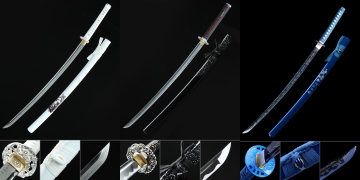
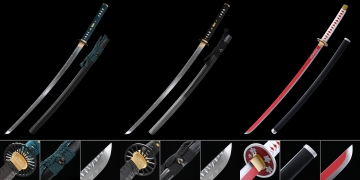
What makes melaleuca steel visually different from other blade steels?
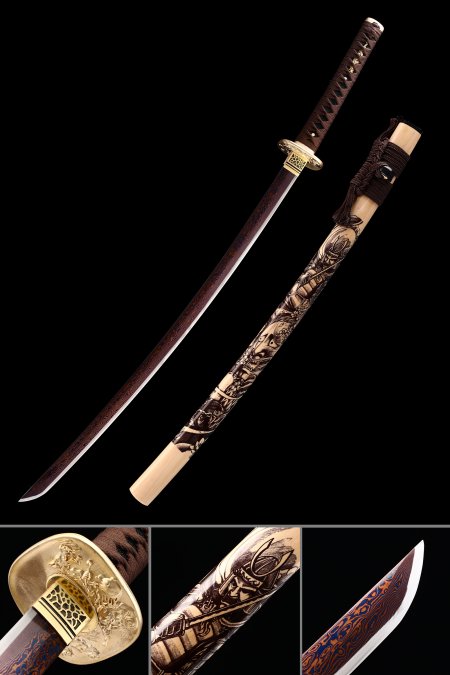
Melaleuca steel gets its distinctive look from the folding process itself. When a smith repeatedly folds and hammers the steel billet - sometimes dozens of times - the alternating layers of hard and soft iron compress into a wood-grain-like pattern visible on the finished blade surface. This texture, sometimes called "jigane" in Japanese or "baimu" in Chinese forging terminology, is unique to each billet because no two folding sequences produce identical layer arrangements. Under direct light, the surface shows faint flowing lines that shift in direction and density. This is fundamentally different from acid-etched pattern-welded steel, where the visual effect is achieved chemically after forging. On a genuine folded melaleuca blade, the pattern is structural - it exists throughout the steel, not just on the surface - which is why collectors consider it a meaningful marker of authentic hand-forging craft rather than decorative finishing.
How does rosewood compare to lacquered wood for a katana saya?
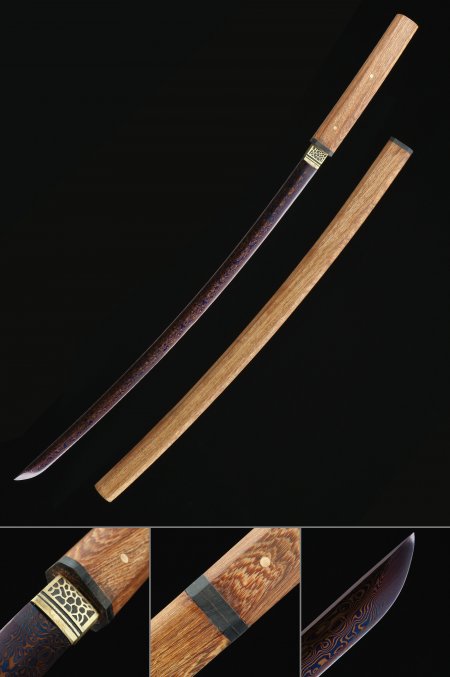
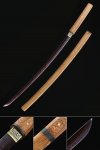
Rosewood and lacquered softwood sayas serve different aesthetic and practical roles in a collection. Lacquered sayas - typically made from magnolia or ho wood - are the historically accurate choice for traditional Japanese mountings, offering a smooth, sealed surface that can be painted or finished in solid colors. Rosewood sayas, by contrast, present the natural grain of the wood as the visual feature, with no paint or lacquer obscuring it. Rosewood is significantly denser and harder than ho wood, which means it resists denting and moisture penetration more effectively in a display environment. The trade-off is weight: a rosewood saya is heavier, which some collectors actually prefer because it balances the overall feel of the mounted piece. For collectors who prioritize the natural material story of a katana - where both the blade and the saya are appreciated as raw, worked materials - a rosewood saya pairs exceptionally well with the organic grain character of a folded melaleuca blade.
What is a hamon, and how do I identify it on a clay-tempered blade?
A hamon is the visible temper line that appears along the edge of a clay-tempered blade, marking the boundary between the hardened edge steel and the softer spine. To see it clearly, hold the blade under a single focused light source - a desk lamp or natural window light works well - and angle the blade slowly. The hamon appears as a misty, undulating line running parallel to the edge, often with small crystalline activity (called "nie" or "nioi") visible within and just above it. On melaleuca steel blades, the interaction between the layered steel structure and the clay tempering process can produce a particularly active hamon with complex internal textures. The shape of the hamon - whether it is straight (suguha), wavy (notare), or clove-pattern (choji) - varies by the smith's clay application technique and is one of the individual characteristics collectors document when cataloguing a piece. A genuine clay-tempered hamon cannot be replicated by acid etching or grinding.
How should I oil and maintain a folded steel blade in a natural wood saya?
Routine maintenance for a folded steel blade in a natural wood saya is straightforward but should follow a consistent schedule. Every two to three months - or after any handling - remove the blade from the saya and wipe the entire surface with a clean, lint-free cloth to remove fingerprint oils and dust. Apply two to three drops of choji oil or food-grade mineral oil onto a second soft cloth and work it across the blade in smooth strokes from spine to edge, moving from habaki toward the tip. Before returning the blade to the saya, ensure the oil coat is thin and even; excess oil can transfer to the interior wood walls and eventually cause swelling. Never use silicone-based products or WD-40, as both leave residues that are difficult to remove and can interfere with the steel's natural patina. In coastal or high-humidity environments, increase oiling frequency to once per month and consider placing a silica gel packet inside the storage area - but never inside the saya itself - to moderate ambient moisture.
Is a natural-wood melaleuca steel katana a good gift for a serious collector?
For a collector who already owns production or entry-level katanas, a hand-forged folded steel piece with a natural wood saya represents a meaningful step up in both craft complexity and display presence. The combination is specific enough to feel considered rather than generic: folded melaleuca steel signals an understanding of forging tradition, while a rosewood or fine hardwood saya signals attention to material quality beyond the blade itself. When selecting as a gift, note the blade finish - a dark red or blue-red damascus surface paired with a gold tsuba offers strong visual contrast and tends to display exceptionally well on a wall mount or stand. Full-tang construction is worth confirming in the product specifications, as it is a detail knowledgeable collectors check immediately. If the recipient collects thematically - shirasaya styles, engraved fittings, or specific regional aesthetics - the product descriptions in this collection include those details clearly, making it easier to match a piece to an existing collection focus.