What makes the gold vine motif significant on a tanto saya?
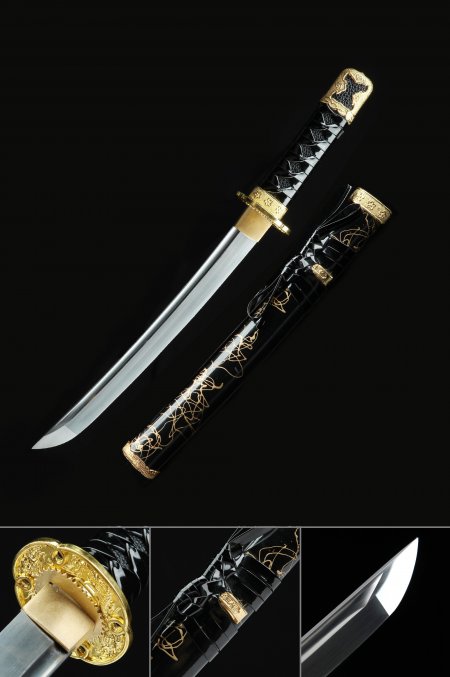
The gold vine motif - known in decorative arts as karakusa - is one of the most enduring ornamental patterns in Japanese lacquerwork. Rendered as continuous intertwining scrolls of stylized vines or foliage, it was widely used by Edo-period craftsmen on lacquered sword furniture, inro, and lacquerware boxes as a symbol of longevity and unbroken continuity. On a tanto saya, gold vine decoration serves both an aesthetic and a hierarchical function: it signals that the piece was assembled with display-quality koshirae rather than a plain shirasaya. For collectors, a gold vine saya immediately communicates that the tanto was intended to be seen and admired as a complete decorative assembly, not merely as an isolated blade.
What is manganese steel, and why is it used in collectible tanto?
Manganese steel is a carbon-manganese alloy that offers good toughness and wear resistance, making it a practical choice for collectible and display-grade blades that need to hold their geometry and surface finish over time without the intensive maintenance demands of high-carbon tamahagane. In tanto production, manganese steel forges cleanly into the characteristic flat cross-section and squared tip geometry of the traditional tanto profile. It accepts both polished and blackened surface treatments, and it responds reliably to heat treatment during production. For collectors focused on koshirae aesthetics - the full assembly of tsuba, handle wrapping, and saya - manganese steel provides a durable, visually appropriate blade foundation without overshadowing the decorative fittings.
How does a tanto differ from a wakizashi in koshirae assembly?
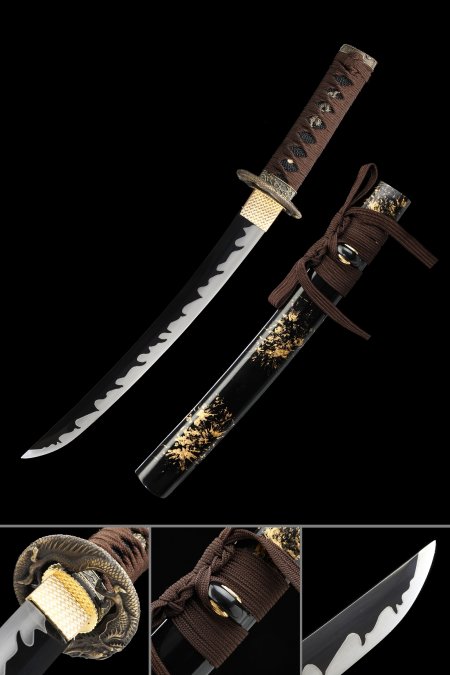
The fundamental distinction is blade length: tanto traditionally measure under one shaku (approximately 30 cm), while wakizashi fall between one and two shaku. This size difference cascades into koshirae proportions - tanto tsuka are shorter, the saya is more compact, and the overall assembly is designed to be worn or carried at a different angle. In decorative koshirae, tanto fittings such as tsuba, fuchi, and kashira are scaled accordingly, which means ornamental details must be executed at a smaller scale while maintaining visual impact. For collectors, this makes high-quality tanto koshirae - especially those featuring raised-relief dragon tsuba and lacquered saya with gold vine work - a particular showcase of the miniaturization skill that Japanese sword furniture craftsmen historically excelled at.
How should I care for a lacquered tanto saya long-term?
Lacquered saya require moderate but consistent attention. The primary threats are humidity fluctuation, direct sunlight, and abrasive contact. Store the tanto horizontally or on a dedicated stand in an environment with stable relative humidity - ideally between 45% and 60% RH. Extremes in either direction can cause lacquer to crack or cloud over time. Avoid placing the saya in direct sunlight, which fades and degrades urushi-style lacquer finishes. When handling, use a soft lint-free cloth rather than bare hands, as skin oils can leave lasting marks on lacquered surfaces. For the blade itself, apply a thin coat of neutral mineral oil or choji oil two to three times per year using a soft cloth, then wipe away any excess before returning the blade to the saya.
Is a tanto with full koshirae a good gift for a sword collector?
A tanto with complete ornamental koshirae is widely regarded as one of the most approachable entry points for new collectors and a genuinely appreciated addition for experienced enthusiasts. Its compact size makes it easy to display in spaces where a full-length katana would be impractical, and a well-assembled koshirae - featuring a detailed dragon tsuba, cord-wrapped tsuka, and lacquered saya - demonstrates the full visual vocabulary of Japanese sword furniture in a single piece. For gift-giving purposes, tanto with distinctive aesthetic themes like gold vine lacquerwork are particularly memorable because they stand apart from generic display pieces. Pairing with a quality tanto stand enhances the presentation significantly.