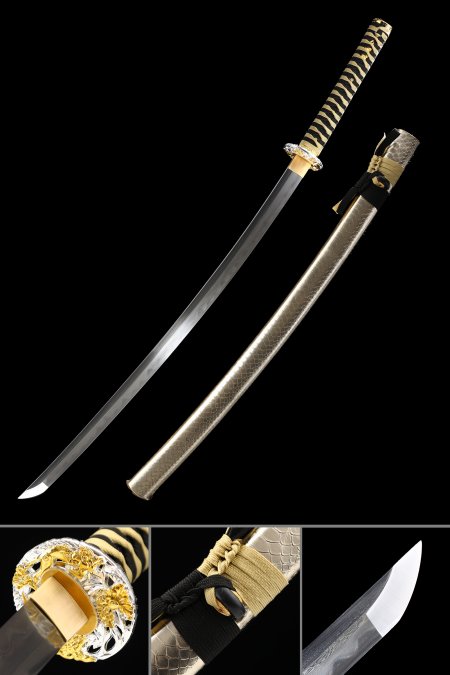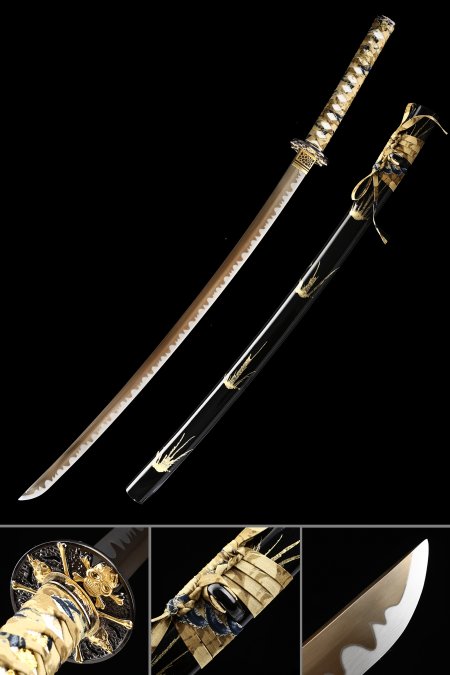
Gold Black Handle Katana

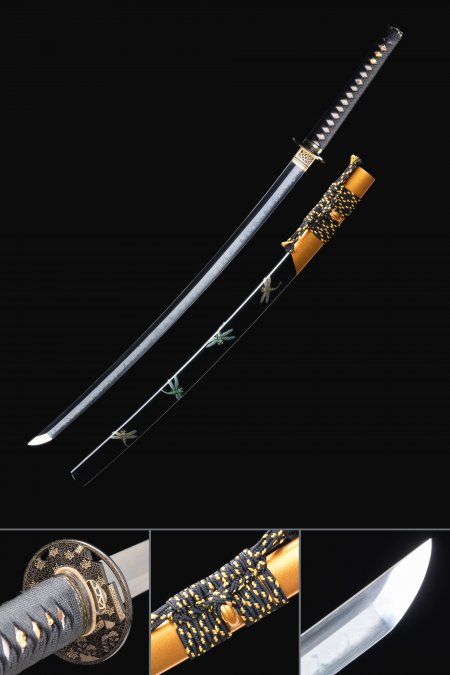
The Gold Black Handle Katana collection brings together swords that balance visual drama with traditional Japanese craftsmanship. Each piece features a hand-wrapped gold-and-black ito handle paired with carefully matched koshirae components — from ornate tsuba to lacquered saya — making every sword a display-worthy centerpiece. Free standard shipping is included on all orders, and we stand behind every purchase with a hassle-free return policy.
Showing 6 Products

Related Collections

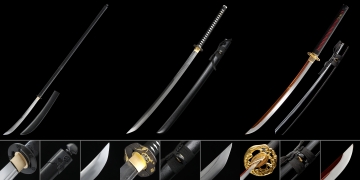
Black Naginata4 items


4 Reviews

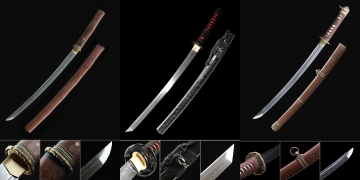
Gold Wakizashi6 items


73 Reviews

Black Aikuchi6 items


5 Reviews

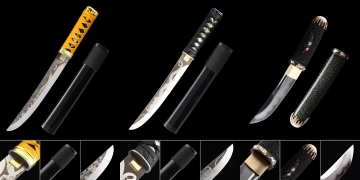
Gold Aikuchi4 items


7 Reviews

Frequently Asked Questions

What makes gold-black ito wrapping different from standard tsukamaki?
Standard tsukamaki uses a single-color ito cord — typically black, dark blue, or burgundy — wound in a repeating diamond pattern over the same-covered handle core. Gold-black ito introduces a second cord color into the braid, requiring the wrapper to alternate strands with greater precision to keep the diamond intersections clean and symmetrical. The result is a visually richer pattern where gold highlights catch light at the raised crossing points, while the black cord provides a grounding contrast. On display, this two-tone wrapping reads as significantly more ornate than single-color work, which is why it is commonly associated with ceremonial or high-koshirae presentation swords rather than utilitarian mountings.
How does T10 clay-tempered steel differ from 1045 or 1090 carbon steel?
T10 is a tool steel with a slightly higher carbon content (around 1.0%) and a small tungsten addition, which improves wear resistance and grain refinement. The critical distinction for collectors is in the tempering process: T10 blades in this collection are clay-tempered, meaning a layer of refractory clay is applied to the spine before quenching. This produces differential hardness — a harder edge, softer spine — and, most importantly, a visible hamon (temper line) that is entirely natural rather than acid-etched. Each hamon is unique. By contrast, 1045 and 1090 carbon steel blades are through-hardened, producing a consistent surface finish without a pronounced temper line. Both are excellent display materials, but T10 clay-tempered blades carry greater individual character.
Are Damascus steel katana in this collection pattern-welded or acid-etched?
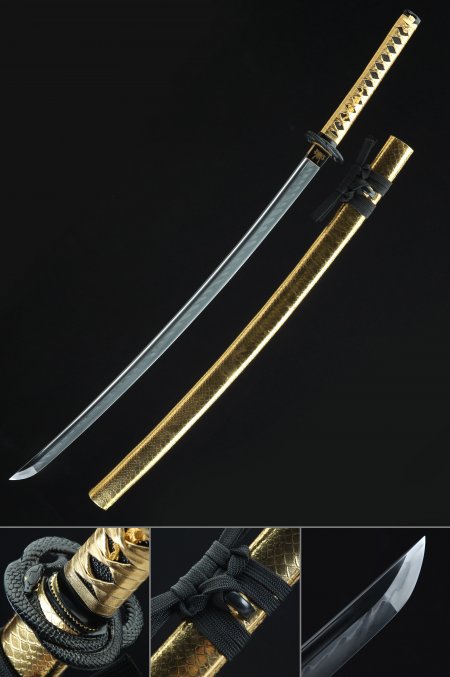
The Damascus steel katana in this collection use pattern-welded construction — multiple steel billets are forge-welded and manipulated through folding or twisting to create the layered grain structure. After grinding and polishing, an acid etch is applied to reveal the contrast between high- and low-carbon layers, making the pattern visible on the surface. This is the historically accurate method used in decorative and high-craft blade production. It is different from blades that merely have an acid-etched pattern applied to homogeneous steel. The visual result on display is a flowing, wood-grain-like surface that catches light differently along its length — a particularly compelling effect when paired with gold-and-black koshirae.
How should I store a gold-black handle katana to protect the ito and fittings?
For long-term display or storage, the primary concerns are humidity, direct sunlight, and contact pressure. Humidity above 60% can cause the same rayskin under the ito to swell slightly, which may loosen the wrap over time, while very low humidity can cause lacquered saya to develop hairline cracks. Aim for a stable environment between 40–55% relative humidity. Keep the sword away from windows or UV light sources, which will fade the gold ito and dull lacquer finishes. If storing horizontally in a bag or box, ensure nothing rests on the handle — sustained pressure can flatten the ito braid's raised diamonds. Apply a light coat of choji oil (clove-infused mineral oil) to the blade every few months and wipe metal fittings with a dry microfiber cloth to prevent tarnish on the gold-finished alloy components.
What display setup works best for a gold-black handle katana as a centerpiece?
A horizontal two-tier sword stand positions the sword with the saya below and the blade above, allowing both the handle wrap and scabbard finish to be appreciated simultaneously — ideal for gold-lacquer or python-scale saya in this collection. If you prefer a vertical presentation, a floor-standing tachi stand shows the full silhouette and makes the koshirae's color contrast immediately readable from across a room. For wall mounting, a horizontal bracket set at eye level with adequate clearance from adjacent pieces works well. Pairing a gold-black katana with a simpler, monochromatic sword on an adjacent stand lets the ornate fittings stand out without visual competition. Avoid placing the sword under halogen spotlights for extended periods, as concentrated heat can affect lacquer and synthetic components over time.

Customer Reviews

Horace E Jones Ii New Jersey, United States

Hello True Katana family this gift was for my father's birthday, and man let me tell you he's extremely happy with this particular Katana very well made with true craftsmanship. The delivery was spot on time and great customer service. I'm most definitely recommending True Katana to other friends that are serious collectors. I myself got my eye on this model
TK-JP-XY20039 and will be leaving a strong review too!

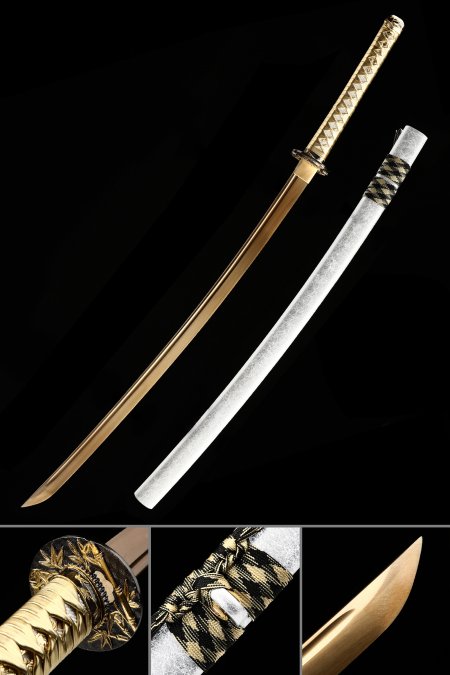
Golden Blade Katana - 1045 Carbon Steel Sword with Bamboo Tsuba in White Saya Golden Blade Katana - 1045 Carbon Steel Sword with Bamboo Tsuba in White Saya
Cart 0 Items

Your cart is empty