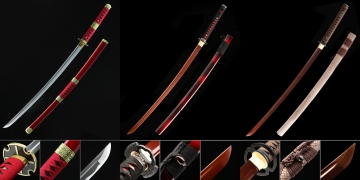
What makes dark red lacquered hardwood saya different from painted finishes?
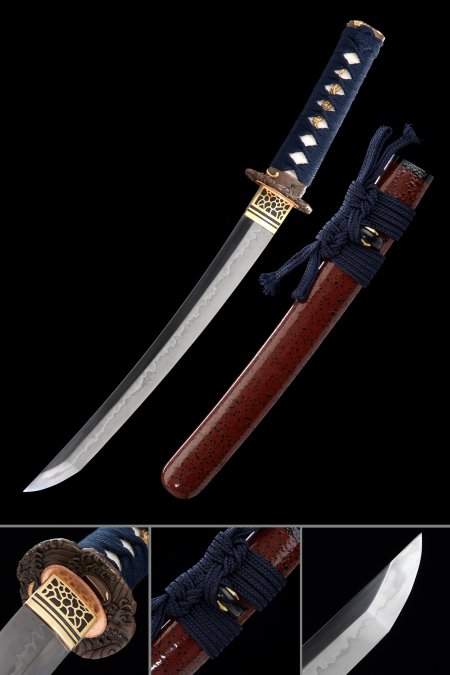
True lacquered hardwood saya are finished with multiple coats of lacquer - traditionally urushi-derived or high-grade synthetic equivalents - each coat applied, dried, and lightly abraded before the next is added. This layering process builds color depth that a single-coat paint finish cannot replicate: the crimson appears to glow from within rather than sitting flat on the surface. Beyond aesthetics, the cured lacquer forms a moisture-resistant shell that helps protect the underlying hardwood from humidity fluctuations, which is a genuine concern for long-term display pieces. A painted saya, by contrast, is prone to chipping at the koiguchi (opening) and along the spine where handling contact is highest. When evaluating a lacquered saya, look for consistency of sheen across the full length and clean, unbroken lacquer edges at both the koiguchi and the kojiri (end cap).
What is the difference between Damascus and T10 steel in a tanto blade?
Damascus steel - more accurately called pattern-welded steel - is made by forge-welding multiple steel billets together and manipulating the combined mass through folding and drawing to create a layered grain structure visible on the surface. Its appeal is largely aesthetic: the flowing hada pattern is unique to each blade. T10 is a mono-steel - a single high-carbon composition with approximately 0.95-1.05% carbon and a small tungsten addition. That tungsten content helps T10 retain a fine grain structure even after the high temperatures of differential clay tempering, producing a hamon with crisp, detailed activity. From a collector's standpoint, Damascus rewards appreciation of surface pattern, while T10 rewards close study of hamon geometry and nie (bright crystalline activity) along the temper line. Neither is inherently superior - they represent different craft traditions and different visual languages.
How should I store a tanto with a lacquered saya long-term?
The two primary threats to a lacquered hardwood saya in storage are sustained high humidity and prolonged direct light exposure. High humidity can cause the hardwood substrate to swell, putting stress on the lacquer layer and potentially causing it to lift or crack near the koiguchi. Store the tanto in an environment with relative humidity between 45% and 55% - a simple hygrometer in your display area is a worthwhile investment. Avoid placing pieces in direct sunlight or under strong UV-emitting spotlights for extended periods, as UV exposure can shift the lacquer tone over time, particularly in deep reds. The blade itself should be lightly coated with a neutral mineral oil or traditional choji oil before extended storage; withdraw it from the saya periodically to check that no condensation has formed inside, which would indicate an environmental control issue.
Is a gold geometric tsuba historically appropriate for a tanto?
Yes - tanto fittings have historically spanned an enormous range from the deliberately minimal to the highly ornate, depending on the patron, period, and intended use of the piece. Gold-accented and geometrically decorated tsuba appear prominently in Edo-period tanto associated with court presentation and formal gift-giving contexts, where elaborate metalwork was expected to signal status and craft patronage. Geometric motifs in Japanese metalwork often carry symbolic references - interlocking patterns suggesting continuity, angular forms associated with protective themes in heraldic tradition. A gold geometric tsuba paired with a Damascus blade and dark red saya is therefore not an anachronism but rather a coherent aesthetic statement rooted in the same formal presentation tradition that produced some of the most elaborate tanto fittings in historical collections.
Can a tanto with a real hamon be identified from one with an acid-etched line?
With some experience, yes. A genuine hamon produced by clay differential tempering has a transition zone - called the habuchi - that exhibits complex crystalline activity: nie (individual bright grains visible to the naked eye) and nioi (a misty, diffuse glow) that shift and catch light as the blade is tilted. The hamon boundary is not a hard line but a gradual transition from the hardened ha (edge) zone into the softer ji (body) of the blade. An acid-etched simulation, by contrast, produces a visually uniform whitened band with a relatively sharp, consistent edge and no crystalline activity - it looks the same regardless of lighting angle. Examining the blade under a single incandescent or natural light source while slowly rotating it is the most reliable informal test: a genuine hamon will appear to move and change character, while an etched line will remain static.