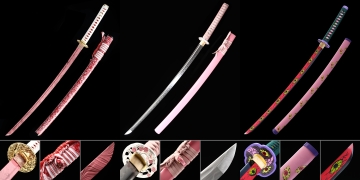
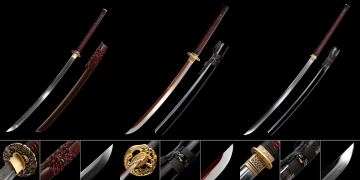
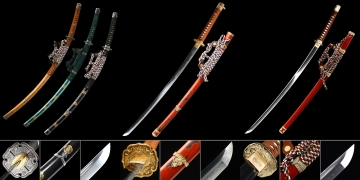
What makes an aikuchi tanto different from a standard tanto?
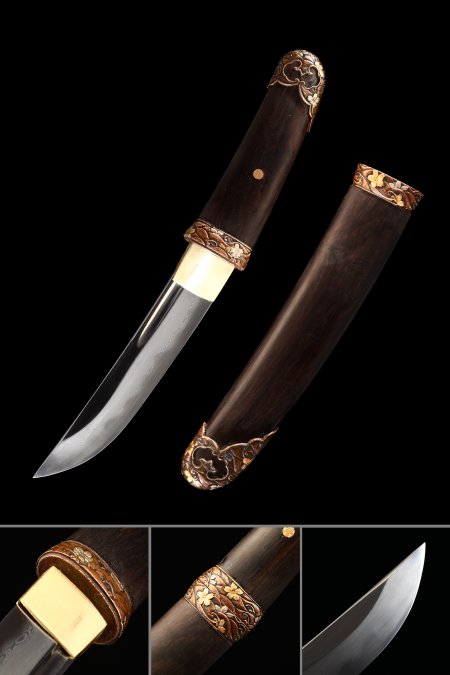
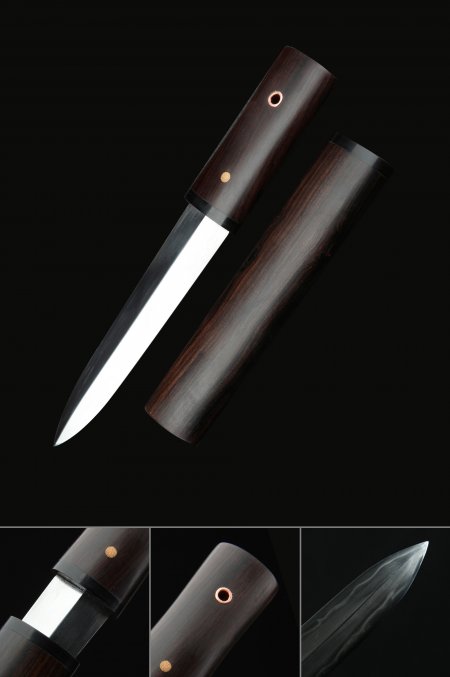
The defining characteristic of the aikuchi style is the absence of a tsuba — the circular hand guard found on most Japanese blade mountings. Without it, the fuchi (collar) of the handle meets the koiguchi (mouth) of the scabbard in a flush, unbroken line. This guardless configuration was historically associated with civilian formal dress rather than martial equipment, favored by court nobility and officials for whom a concealed, elegantly mounted blade was a status marker. On a display stand, the clean profile of an aikuchi reads as distinctly more architectural and minimalist than its tsuba-fitted counterparts.
How is the dark red finish achieved on the wooden saya?
The burgundy color on these scabbards is the result of layered staining applied directly to the raw hardwood — species like sandalwood absorb pigment deeply into the grain rather than sitting as a surface coat. Once the desired depth of color is reached, the wood is sealed under lacquer to protect it from humidity fluctuations and oils transferred through handling. This process means the red tone has genuine visual depth: in direct light it reads as warm crimson, while in lower light it shifts toward mahogany. The lacquer layer also makes routine maintenance simple — occasional dry-wiping is sufficient to preserve the finish for long-term display.
What is Damascus steel, and why does every blade look different?
Damascus steel in this context refers to a pattern-welded construction: two or more steel alloys with differing carbon content are stacked, heated, and folded together multiple times. The mechanical working at high temperature causes the layers to elongate and flow, creating the distinctive banded or watered grain pattern visible on the finished blade surface. Because each fold sequence is done by hand and the metal moves organically under the hammer, the resulting hada — the surface grain — is unrepeatable. Two blades forged from the same billet will still show meaningfully different patterns. For collectors, this makes each piece genuinely one-of-a-kind rather than a production duplicate.
How should I store and maintain a lacquered wood saya?
Lacquered hardwood scabbards are relatively forgiving but respond poorly to extremes. Avoid storing them in direct sunlight, which degrades lacquer and can cause the wood to develop fine surface cracks over time. Relative humidity between 45–55% is ideal; very dry environments cause the wood to contract, which can loosen the fit between saya and blade. For routine care, a soft dry cloth removes fingerprints and dust without risk to the finish. Never use solvent-based cleaners. The blade itself — if high-carbon steel — should be lightly wiped with a neutral mineral oil before storage to prevent oxidation on the surface.
Is a Dark Red Saya Aikuchi a good choice as a display gift?
This style translates exceptionally well as a gift for Japanese blade enthusiasts, history collectors, or anyone drawn to East Asian decorative arts. The color combination of burgundy lacquered wood, copper fittings with relief detailing, and patterned steel blade makes an immediate visual impression without requiring explanation. Because the aikuchi form is historically associated with refined civilian culture rather than martial use, it tends to be more approachable for recipients who may not have a deep sword-collecting background. Presenting it on a simple horizontal stand elevates the display further — the clean guardless profile is best appreciated when the full length of the mounting is visible.