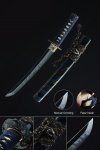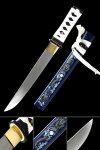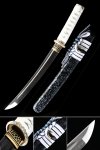
Dark Blue Saya Tanto

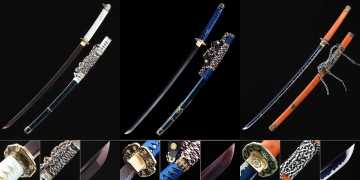
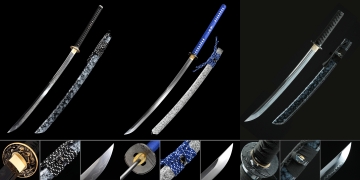
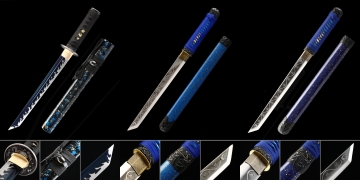
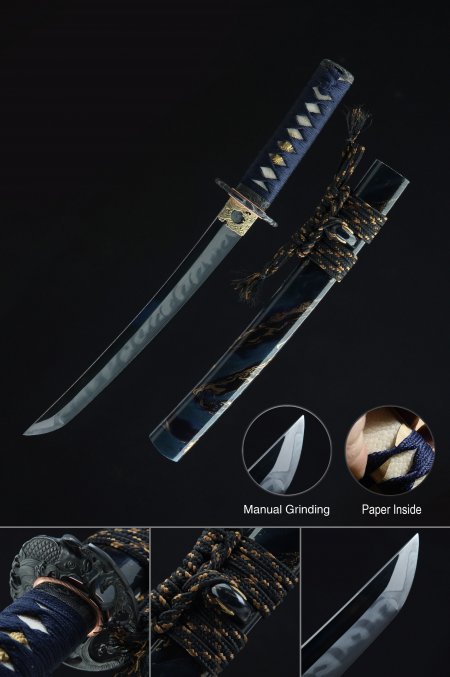
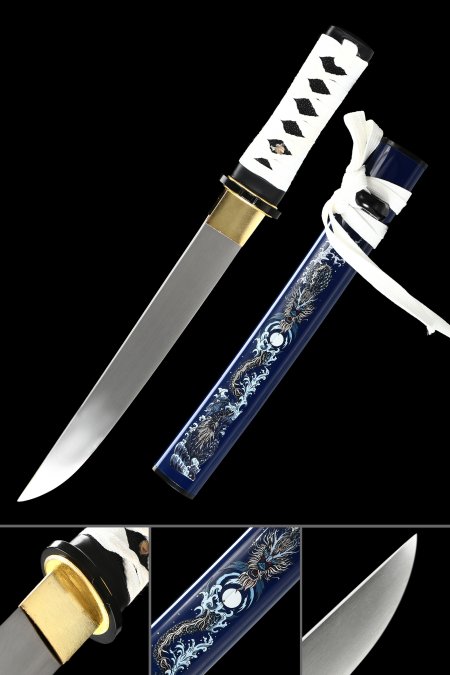
Dark blue saya tanto blades unite traditional Japanese short-sword craftsmanship with a distinctly refined aesthetic — the deep indigo lacquer finish giving each piece an air of quiet authority that stands apart on any display shelf. From clay-tempered T10 steel with genuine hamon activity to hand-fitted dragon-carved hardwood saya, every detail is selected with the discerning collector in mind. All orders ship free with hassle-free returns.
Showing 3 Products

Related Collections

Purple Katana22 items


99 Reviews

Blue Odachi4 items


16 Reviews

Blue Naginata3 items


7 Reviews

Blue Hamidashi3 items


3 Reviews

Frequently Asked Questions

What makes a real hamon different from an etched one?
A genuine hamon forms during the clay tempering process, where a thin layer of refractory clay is applied along the spine before the blade is quenched in water. The differential cooling rate creates a hard martensitic edge and a softer pearlitic spine, with the boundary zone — the hamon — displaying natural activity like nie (crystalline granules) and nioi (a misty, nebulous glow). An etched or painted hamon is purely cosmetic, applied after the fact with acid or pigment, and carries none of the metallurgical complexity. On T10 clay-tempered tanto like those in this collection, the hamon is a direct record of the quenching process, meaning every blade's pattern is one-of-a-kind and cannot be replicated.
How does T10 carbon steel compare to stainless for a display tanto?
T10 carbon steel has a carbon content around 1.0%, giving it a fine grain structure and excellent capacity to hold a well-defined hamon when clay tempered — qualities that stainless steel cannot replicate under traditional differential quenching. Stainless alloys require chromium content above 10.5%, which interferes with the quenching chemistry needed to produce genuine hamon activity. For collectors who prioritize metallurgical authenticity and the visual character of traditional Japanese bladesmithing, T10 is the more meaningful choice. The trade-off is that carbon steel requires light periodic oiling to prevent surface oxidation, whereas stainless is more forgiving in humid environments. For display purposes in a controlled indoor setting, T10's visual and craft advantages far outweigh its modest maintenance requirements.
Does the dark blue lacquer on the saya require special care?
Dark blue lacquered saya are finished with pigmented urushi-style lacquer over a hardwood core. To preserve the depth and gloss of the indigo finish, keep the saya away from prolonged direct sunlight, which can cause fading or micro-cracking over time. Avoid storing the tanto in high-humidity environments — a wall mount or enclosed display case with silica gel packets is ideal. If the saya surface picks up fingerprints or light dust, wipe gently with a dry microfiber cloth. Do not use solvents, alcohol wipes, or furniture polish, as these can dull or strip the lacquer. With minimal care, a quality lacquered saya will retain its color and finish for many years as a display piece.
Are dragon motifs on tanto fittings historically grounded?
Yes. Dragon imagery has appeared on Japanese sword fittings — tsuba, fuchi, kashira, and menuki — since at least the Muromachi period. In Japanese cultural tradition, the dragon (ryu) represents wisdom, protection, and the dynamic forces of water and sky, making it a natural choice for decorating the fittings of a blade carried by a warrior or nobleman. Unlike the fire-breathing dragon of European heraldry, the Japanese ryu is typically depicted as a serpentine, cloud-dwelling creature associated with rain and rivers. On the tanto in this collection, dragon motifs on cast alloy tsuba and carved hardwood saya reflect this iconographic heritage, giving each piece a layer of symbolic meaning that complements its visual appeal as a display collectible.
How should I display a tanto alongside a katana or wakizashi?
The classic Japanese display arrangement places blades on a horizontal katana stand (katana kake) in descending order of length — katana on top, wakizashi in the middle, tanto at the base or on a separate smaller stand. For a dark blue saya tanto, pairing with other indigo or navy-toned pieces creates visual cohesion across a shelf or wall display. If mixing saya colors, unifying the fittings — matching gold-tone tsuba or consistent ito wrap colors — helps the grouping read as intentional rather than random. A tanto displayed edge-up (ha up) on a horizontal stand is the traditional Japanese orientation for a stored blade. For collectors expanding their display, our full tanto collection offers a wide range of saya tones and blade treatments to build a complementary set.

Customer Reviews

Richard Dale Parsons Texas, United States

I’m no sword smith, but I am a satisfied customer. The Tanto is very nice and I did choose the T10 steel for its strength and edge retention capabilities. The hamon line is nice with nice graying. Shipping and delivery was fast. I waited for the Tanto to decide whether or not to order a Wakizashi and I did. If it’s appearance and quality is what I’m expecting I’ll be ordering a Katana.

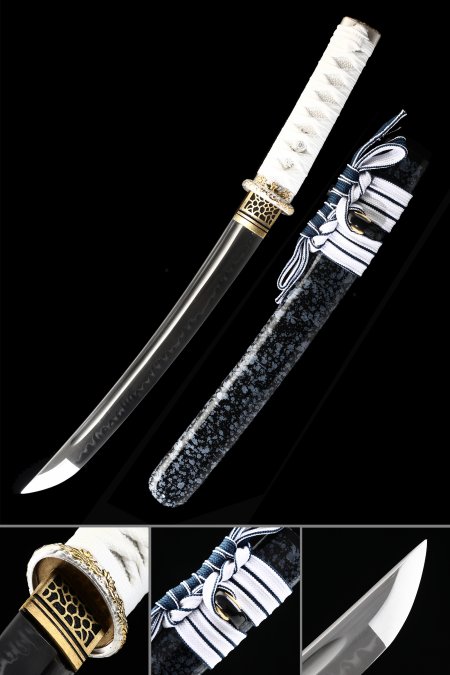
Clay Tempered T10 Steel Tanto with Real Hamon in Dark Blue Dragon Saya - Gold Alloy Wave Tsuba Clay Tempered T10 Steel Tanto with Real Hamon in Dark Blue Dragon Saya - Gold Alloy Wave Tsuba
Cart 0 Items

Your cart is empty