What makes a brown tsuba distinct from other guard colors?
A brown tsuba achieves its tone through one of several finishing methods: natural iron oxidation that develops a warm rust-patina over time, lacquer application over a wood or alloy base, or chemically accelerated patination on iron blanks. Unlike polished silver or jet-black guards, a brown finish interacts with ambient light subtly, shifting between amber and deep umber depending on the angle. This tonal range gives it an organic, aged quality that collectors associate with authentic antique fittings. For display purposes, brown guards also photograph exceptionally well alongside natural wood saya and earth-tone ito wraps, producing a visually cohesive piece without any single element overpowering the others.
How does T10 steel differ from 1095 in a wakizashi?
Both T10 and 1095 are high-carbon steels favored in hand-forged Japanese-style blades, but their composition differs in one key area: T10 contains a small percentage of manganese and trace tungsten, which tightens the grain structure during forging and supports more consistent differential hardening. This means T10 blades can develop a more defined hamon — the temper line produced by clay tempering — making them particularly attractive for collectors who value visible craftsmanship. 1095, by contrast, is a purer high-carbon steel that responds predictably to heat treatment and is well-regarded for its balance of hardness and toughness. Both are excellent choices for display-grade wakizashi; T10 tends to appeal to collectors focused on blade aesthetics, while 1095 suits those prioritizing traditional simplicity.
Can a wakizashi be displayed as a standalone piece or only in a daisho set?
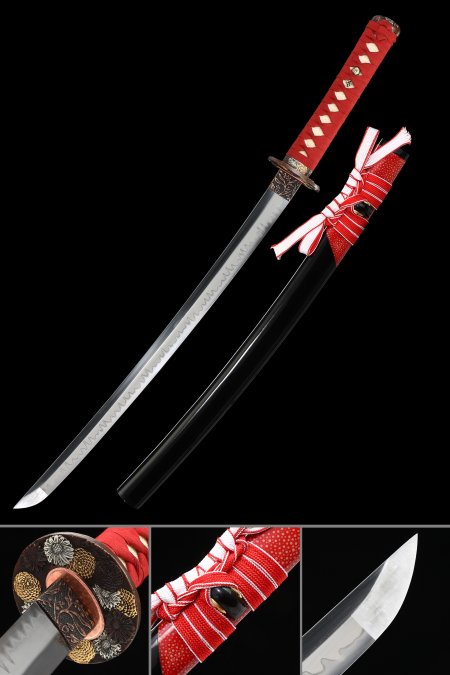
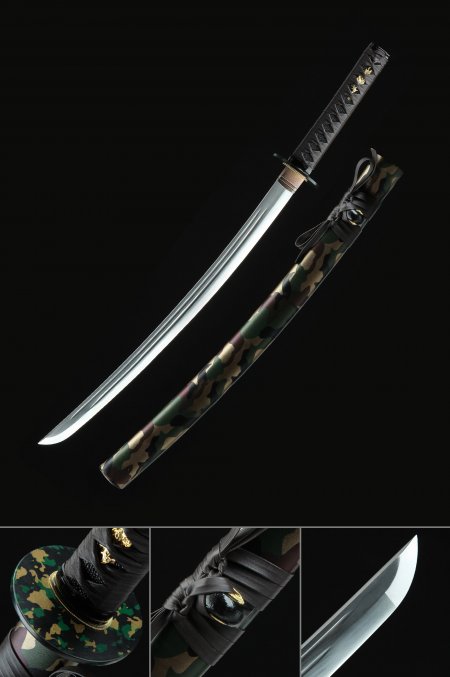
A wakizashi displays beautifully as a standalone collectible. Historically, the short blade held its own ceremonial and practical role independent of a paired katana, and many collectors today choose to display a single wakizashi precisely for its compact proportions and the detailed craftsmanship that becomes more visible at a shorter length. A brown tsuba wakizashi mounted on a single-tier sword stand, positioned horizontally with the saya facing outward, creates a focused display that draws attention to the guard, the ito pattern, and the blade geometry. That said, pairing it with a matching katana as a daisho arrangement adds historical context and creates a more expansive visual presentation for larger display cases or dedicated sword walls.
How should I maintain a wakizashi stored in a lacquered saya?
Proper maintenance of a wakizashi in a lacquered saya involves two separate care routines. For the blade, apply a thin, even coat of choji oil or a food-grade mineral oil every one to three months using a soft, lint-free cloth — this prevents oxidation on high-carbon steel surfaces. Before re-oiling, remove the previous layer with a clean cloth to avoid buildup. For the lacquered saya, avoid prolonged contact with moisture and do not use oil or polish on the exterior, as lacquer finishes can cloud or crack when exposed to solvents. Store the assembled piece horizontally in a low-humidity environment, ideally between 40–55% relative humidity, and away from direct sunlight, which can fade both lacquer and ito wrap over time.
Is a brown tsuba wakizashi a good gift for a Japanese sword enthusiast?
A brown tsuba wakizashi makes a genuinely thoughtful gift for a collector at any level. For someone new to Japanese sword collecting, a wakizashi is an accessible entry point — its shorter size makes it easier to display and handle safely, and the brown tsuba immediately signals aesthetic intentionality rather than generic styling. For experienced collectors, the specific steel type, tsuba finish, and ito color combination offer meaningful differentiation from pieces they likely already own. When selecting a gift, consider whether the recipient favors minimalist fittings or layered detail — a black lacquer saya with brown tsuba and contrasting ito creates a sophisticated palette, while a natural wood saya with brown guard leans more rustic and organic. Either direction reflects genuine curatorial thought.