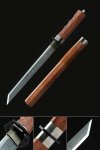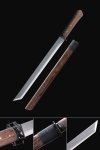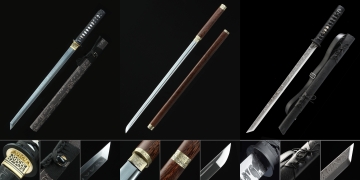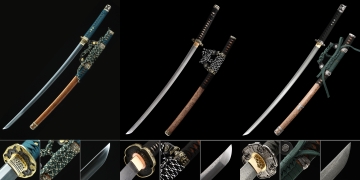
Brown Handle Hamidashi

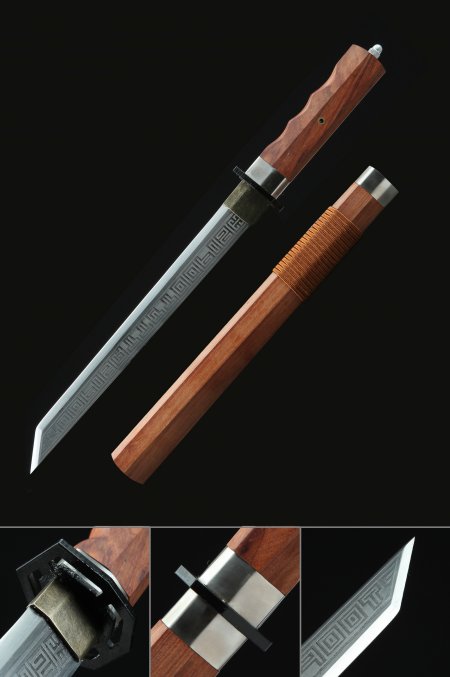
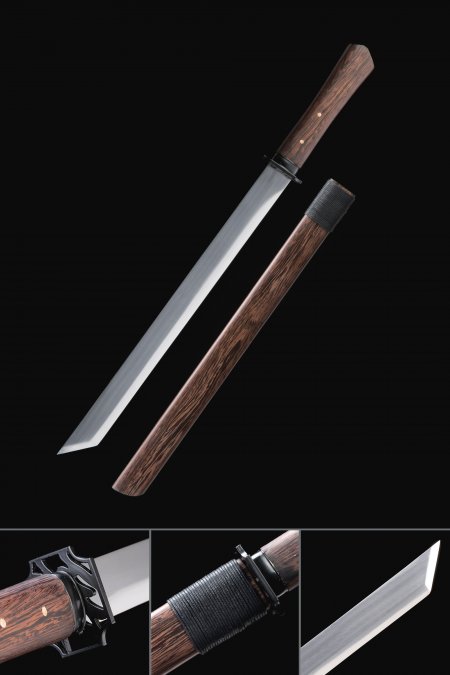
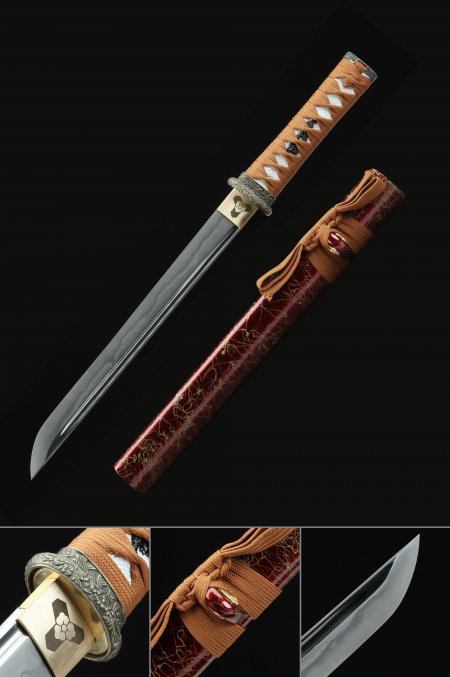
Brown handle hamidashi tanto combine the understated elegance of wrapped cord grips with the refined silhouette of a guardless short sword. Each piece in this collection showcases hand-forged T10 carbon steel blades, clay tempering techniques, and carefully matched rosewood or natural wood saya — details that serious collectors recognize immediately. Free standard shipping is included on every order, and we stand behind each piece with a straightforward return policy.
Showing 3 Products

Related Collections

White Katana56 items


787 Reviews

Brown Wakizashi6 items


71 Reviews

Brown Ninjato8 items


34 Reviews

Brown Odachi7 items


36 Reviews

Frequently Asked Questions

What makes a tanto a hamidashi style?
The hamidashi is defined by its minimal tsuba — rather than a full circular or decorative guard, it features only a small rim, or in the aikuchi variant, no guard at all. This design lets the tsuka and saya meet in an almost seamless line, giving the piece a sleeker, more integrated silhouette than a standard tanto mounting. Collectors value this form for its restrained elegance: every element of the handle and scabbard becomes more visually prominent when there is no guard to draw the eye. The brown cord wrap on the tsuka is especially noticeable in this style, since nothing interrupts the transition from handle to blade.
What is T10 steel, and why is it used in these tanto?
T10 is a Chinese-designation high-carbon tool steel containing roughly 1.0% carbon along with a small amount of tungsten, which contribuves to a fine grain structure and good wear resistance. In tanto production, T10 is favored because it responds well to differential clay tempering — the heat-treatment process that creates a visible hamon along the blade. The steel reaches a high surface hardness at the edge while the spine retains more flexibility, which is the same metallurgical principle behind traditional Japanese tamahagane blades. For display collectors, T10 tanto offer an authentic look and feel that mirrors historical forging methods at an accessible price point.
How do I read the hamon on a clay-tempered blade?
The hamon is the boundary line between the hardened edge zone (hagane) and the softer spine (mune), made visible through polishing after quenching. On a clay-tempered T10 tanto, you will typically see the hamon as a lighter, misty band running parallel to the cutting edge. Within and along this line, look for activity: nie are bright, sand-like crystalline particles visible under direct light, while nioi appears as a softer, smoky haze. On pieces described as having an engraved geometric hamon, the line follows a deliberate angular or wave pattern applied during finishing. Viewing the blade under a single-point light source at a low angle brings out the most detail.
How should I store a rosewood saya tanto for long-term display?
Rosewood saya are naturally dense and moderately oil-resistant, but the blade inside still requires periodic maintenance. Every three to six months, remove the blade, wipe it clean with a soft cloth, apply a thin coat of choji oil or mineral oil, and allow it to absorb before re-sheathing. Store the mounted tanto horizontally or at a slight downward angle (edge up) in a low-humidity environment — relative humidity between 40% and 60% is ideal. Avoid placing the piece in direct sunlight, which can bleach the cord wrap and dry out the saya lacquer over time. A wooden display stand with felt lining distributes pressure evenly and prevents contact marks on the saya finish.
How does a hamidashi differ from a standard aikuchi tanto?
Both styles remove or reduce the tsuba, but the distinction lies in the fuchi-kashira fitting at the base of the handle. An aikuchi mounting has no guard whatsoever — the fuchi sits flush against the habaki, and the saya mouth closes directly around the collar. A hamidashi retains a very small rim guard, roughly the diameter of the handle, that just barely protrudes beyond the tsuka. In practice, this gives the hamidashi a faint visual stop between handle and blade, while the aikuchi is fully continuous. On display, the aikuchi reads as more minimalist; the hamidashi has a subtle structural accent that many collectors find adds just enough definition without disrupting the clean line.

Customer Reviews

Matthew Andrews Utah, United States

Product showed up yesterday to my partners place. They said that it was good quality the pictures all looked great! Great customer service as well, there was a small issue with the address and costumer service helped me get it sorted out in a timely manner. All in all a good experience.

Hamidashi Tanto Manganese Steel With Engraved Geometric Hamon In Rosewood Saya Hamidashi Tanto Manganese Steel With Engraved Geometric Hamon In Rosewood Saya
Cart 0 Items

Your cart is empty