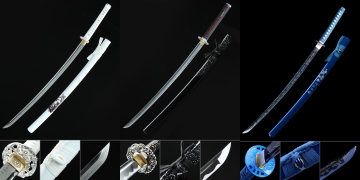
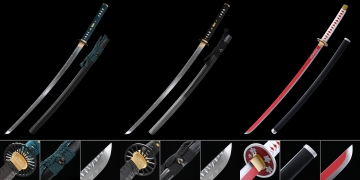
What does "Melaleuca steel" mean in a katana blade?
"Melaleuca" describes the multi-layer folded steel construction used to form the blade. The smith repeatedly folds and forge-welds the steel billet, a process that creates a flowing woodgrain-like surface pattern visible after polishing and etching. Because each fold cycle redistributes the layers differently, no two blades produce an identical pattern. This makes Melaleuca steel katanas distinctly collectible — the surface itself is a permanent record of the forging process, something a ground or machine-finished blade simply cannot replicate. The layering also contributes to the blade's visual depth, catching light differently across flat, shinogi, and edge zones.
Why is a bronze tsuba better than zinc alloy for display?
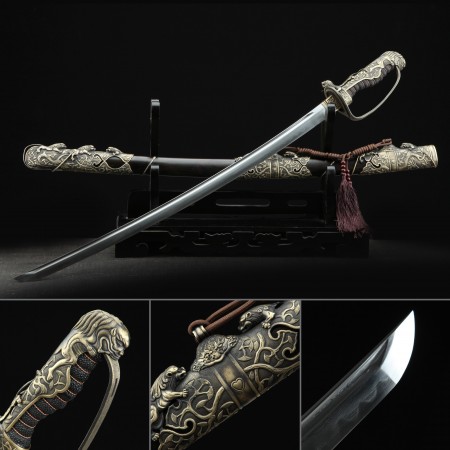
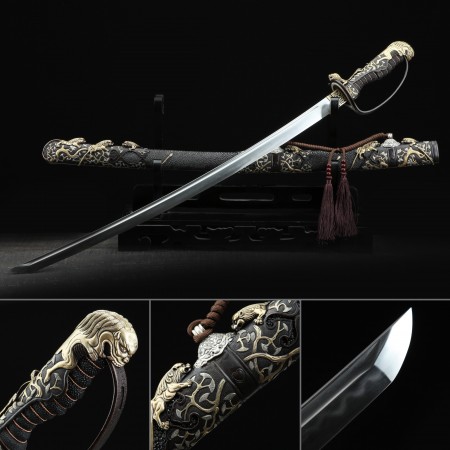
Bronze and zinc alloy (often marketed as "zinc die-cast") differ significantly in density, detail retention, and long-term appearance. Bronze is a denser, harder alloy that accepts finer mold detail during casting, producing crisper relief on motifs like the lion face. In hand, a solid bronze tsuba feels substantially heavier and more substantial than a zinc equivalent of the same dimensions. Crucially, bronze develops a natural patina over years of display — a gradual deepening of tone that most collectors find desirable. Zinc alloy, by contrast, tends to show surface degradation or white oxidation spotting over time, particularly in variable humidity environments. For a piece intended for long-term display, bronze fittings represent a meaningful quality step.
Is the hamon on these blades real or decorative?
The hamon on Bronze Melaleuca Steel Katanas is genuine — produced by differential clay-coating the blade before the hardening quench, not by acid etching. During heat treatment, clay applied along the spine insulates that zone from rapid cooling, while the edge cools quickly and hardens into a finer crystalline structure called martensite. The boundary between these two zones is what appears as the hamon line. Because it reflects actual metallurgical variation rather than a surface treatment, the hamon changes character under different lighting angles, appearing bright and active under direct light and subtle under diffuse light. This optical behavior is what experienced collectors use to distinguish a genuine hamon from an etched imitation.
How should I maintain a lacquer saya for long-term display?
Black hardwood lacquer sayas are durable but sensitive to sustained direct sunlight and rapid humidity swings. UV exposure over time fades the lacquer's depth and can cause micro-cracking along the wood grain. For display, position the katana away from windows or use UV-filtering glass if the display cabinet is sun-facing. Humidity ideally stays between 40–60% RH; extremes in either direction cause the wood substrate to expand or contract, which stresses the lacquer coating. Avoid resting the saya on rough surfaces that can scratch the finish. Occasional gentle wiping with a dry microfiber cloth removes dust without abrading the surface. Do not use furniture polish or solvent-based cleaners, as these can lift or cloud lacquer finishes.
How does this collection pair with a display stand for gifting?
The Bronze Melaleuca Steel Katana series makes a strong gifting choice for collectors who appreciate both metallurgical craft and cohesive ornamental design. The lion koshirae and rich saya finishes photograph well and present impressively without additional accessories, but pairing with a two-tier hardwood katana stand completes the display presentation and immediately gives the recipient a ready-to-display setup. For gifting purposes, the rayskin saya variant — with its black-and-gold contrast — tends to read as the more formal option, while the plain black lacquer saya suits a cleaner, more minimalist display aesthetic. Both variants are full-tang constructions, which collectors familiar with the category recognize as an indicator of structural integrity in the blade assembly.