What gives a Damascus tanto its unique blade pattern?
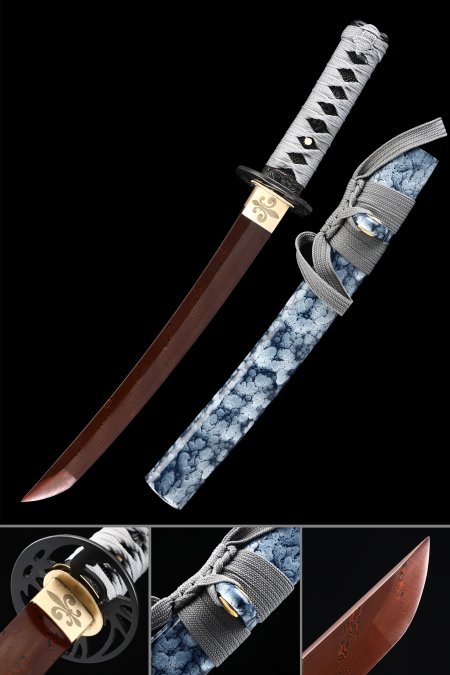
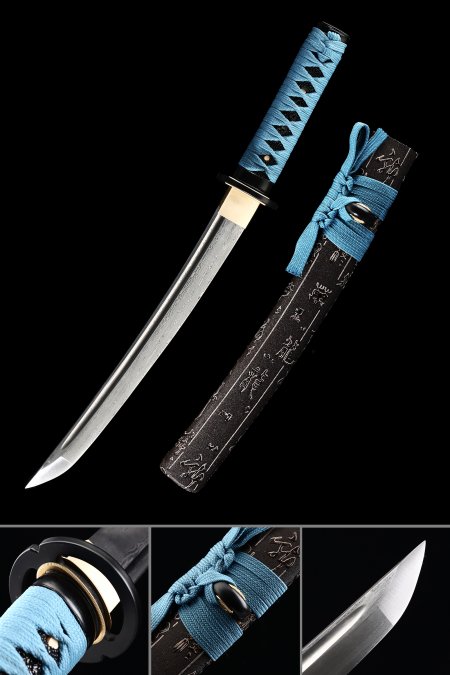
The distinctive visual pattern on a Damascus tanto comes from pattern-welding: two or more steel alloys are forge-welded together, then repeatedly folded, twisted, and drawn out. As the layers compress and flow under heat, they create the characteristic rippling, wavy, or ladder-grain designs visible across the blade surface. No two pattern-welded blades are identical — the grain is a direct record of how that specific billet was manipulated by the smith. On a blue-finish tanto, the contrast between the blue surface treatment and the exposed steel grain becomes even more pronounced, making the layered structure one of the piece’s most celebrated visual features.
How is the blue color applied to a Damascus steel blade?
The blue finish on a Damascus steel tanto is typically achieved through a controlled oxidation or chemical patination process applied after the blade has been ground and polished. Heat bluing involves carefully bringing the steel to a specific temperature range where a thin, stable oxide layer forms on the surface, producing colors that shift from straw gold through blue-violet depending on precise heat control. Chemical blueing uses an acid or salt solution to develop a similar oxide layer at room temperature. Both methods are permanent under normal display conditions, though they can be affected by abrasive cleaning or prolonged exposure to moisture, which is why gentle care and periodic oiling are recommended for long-term preservation.
How does a tanto differ from other Japanese blade formats?
A tanto is a Japanese short blade, traditionally falling under 30 cm in blade length, as opposed to the wakizashi (mid-length) or katana (long blade). The tanto’s defining structural features include a thick spine relative to blade width, a reinforced point designed for geometric strength, and a compact overall form. In pattern-welded collectible tanto, these proportions are preserved faithfully, giving the piece an authentic silhouette that reads as distinctly Japanese even when displayed alongside decorative elements like an engraved saya or a multi-color ito wrap. Collectors who own both katana and tanto often display them together as a complementary daisho-style grouping.
What is the best way to display and store a tanto collectible?
For display, a horizontal katana stand or a dedicated tanto rack positions the piece at an angle that shows off both the blade geometry and the saya lacquerwork simultaneously. Avoid placing the display near windows where UV exposure can fade the ito wrap and the blue surface finish over time. When storing the blade outside its display setting, keep it in the saya to protect both the finish and the scabbard interior from dust and humidity. Apply a thin coat of blade-specific oil — such as choji oil — to the steel every three to four months using a soft cloth. Never use household cleaners or abrasive materials, as these can strip the blued finish and disrupt the pattern-welded surface.
Are blue Damascus tantos a good choice as a collector gift?
Yes — a blue blade Damascus tanto is one of the more visually arresting collectible gifts in the Japanese blade category precisely because it combines multiple points of visual interest: the fluid grain of pattern-welded steel, the bold color finish, and decorative fittings such as kanji-engraved sayas or contrast-wrapped handles. This layered visual complexity makes it a compelling display piece even for recipients who are new to blade collecting. For experienced collectors, the craftsmanship details — ito wrap style, saya material, and blade geometry — provide genuine points of appreciation beyond surface aesthetics. Pairing a tanto with a matching Damascus katana from a related collection creates a cohesive two-piece display that carries additional collectible significance.