What gives the tanto blade its blue color?
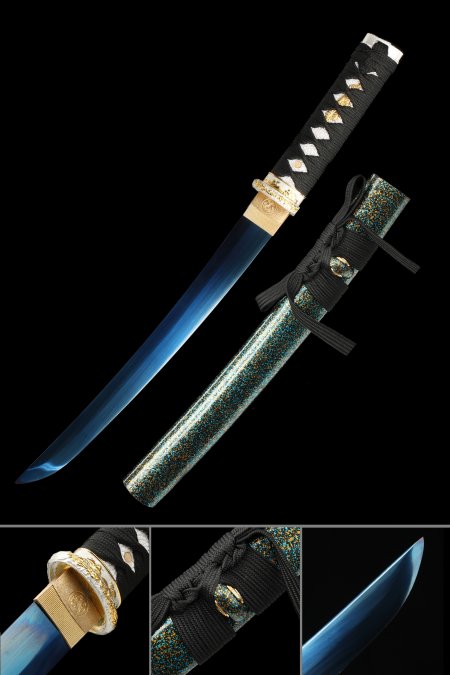
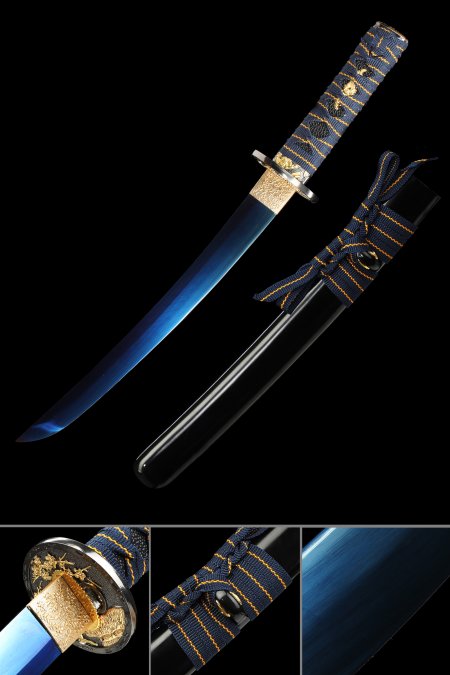
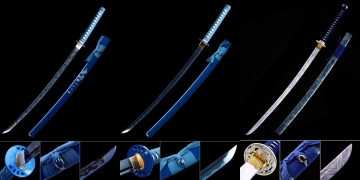
The blue finish on these tanto blades is achieved through a controlled bluing process - a form of deliberate surface oxidation applied to the 1060 carbon steel after shaping and polishing. Unlike paint or powder coating, bluing forms a thin iron oxide layer directly bonded to the steel surface. This produces the distinctive cool blue-grey tone you see on each blade. Beyond aesthetics, the oxide layer offers a modest degree of protection against surface moisture, making it a practical choice for display collectibles. The depth and consistency of the color depends heavily on how evenly the heat or chemical process is applied, which is why well-executed bluing is considered a mark of careful finishing work.
How does 1060 steel compare to 1045 or 1095 in a tanto?
The number in each steel designation refers to its carbon content in hundredths of a percent - so 1045 contains roughly 0.45% carbon, 1060 around 0.60%, and 1095 approximately 0.95%. For a display tanto, 1060 occupies a practical middle ground. It is harder and holds edge geometry more crisply than 1045, which is often considered an entry-level carbon steel. Compared to 1095, it is somewhat more forgiving during the forging and heat-treatment stages, with slightly lower brittleness - a meaningful consideration when producing tanto with the precise geometry and consistent blade profile that collectors value in finished display pieces.
What is the best way to store a blue-bladed carbon steel tanto?
Carbon steel, including 1060, is reactive to moisture and will develop surface rust if neglected - even a blued finish does not make it immune. For long-term display or storage, apply a thin coat of choji oil or a high-quality mineral oil to the blade surface every few months, or more frequently in humid climates. Store the tanto in its saya when not on display, as the wooden scabbard provides a degree of environmental buffering. Avoid sealed plastic cases without desiccants, as trapped humidity accelerates oxidation. A climate-controlled display case with a silica gel packet is the preferred solution for serious collectors looking to preserve both the blade finish and the lacquer saya.
Does the tsuba style affect the collectible value of a tanto?
For display and decorative collectibles, tsuba selection is one of the most visually impactful mounting decisions. The tsuba - the guard fitted between the handle and blade - contributes significantly to the overall aesthetic balance of the piece. Gold and gold-white tsuba, like those found in this collection, create a deliberate visual counterpoint to the cool blue blade, producing a contrast that reads as intentional and refined rather than incidental. From a collector's perspective, matched mountings - where the tsuba, saya lacquer color, and handle cord work together as a cohesive set - tend to be more desirable than mismatched configurations. These details are worth evaluating carefully when selecting a tanto for display.
Can a tanto be displayed alongside a katana as a matched set?
Yes, and this is in fact a traditional Japanese display convention. Historically, a katana and tanto (or katana, wakizashi, and tanto) were worn together as a matched set called a daisho or a coordinated grouping. For modern collectors, pairing a blue blade tanto from this collection with a blue blade katana creates a visually unified display where both pieces share the same oxidized finish, lacquer palette, and hardware style. This kind of thematic pairing is a popular approach for wall-mounted displays or tiered blade stands, and it reflects an understanding of Japanese blade aesthetics that elevates the overall presentation well beyond displaying mismatched individual pieces.