What makes a hamon on a T10 tanto genuine vs. etched?
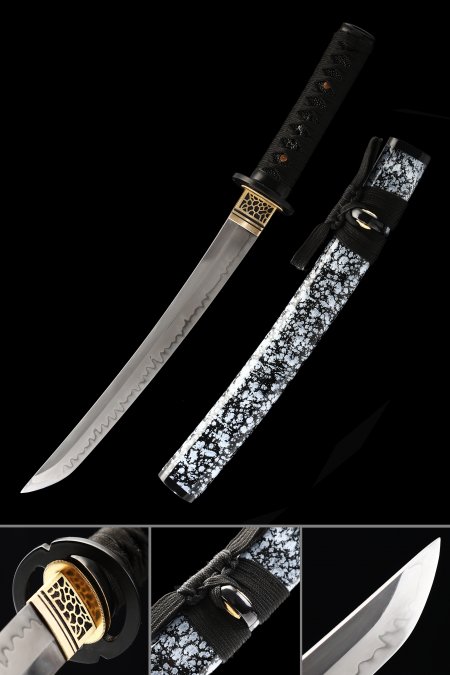
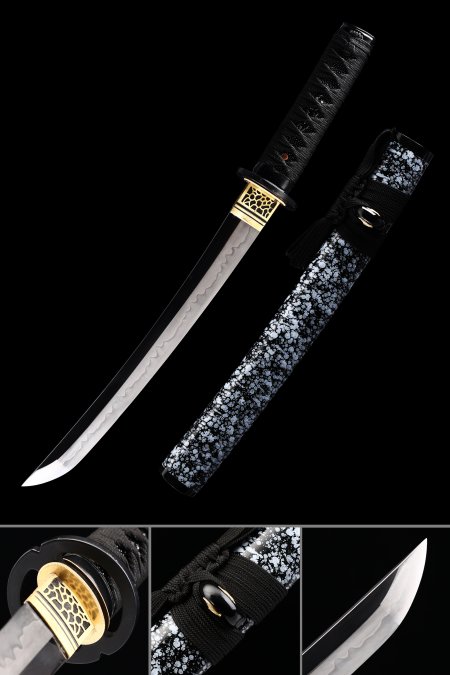
A genuine hamon forms during clay tempering, when the blade is coated with differential clay, heated, and quenched. The clay insulates the spine, causing the edge to cool faster and harden at a higher level - the hamon is the visible boundary between these two zones. It will show activity, nie (crystalline granules), and natural irregularity when examined under light. An etched or acid-washed hamon, by contrast, is applied after the fact to mimic the appearance without the underlying metallurgical change. On a T10 tanto in this collection, the hamon is the result of the actual tempering process, meaning it reflects real differential hardness along the blade - a meaningful distinction for collectors who value authenticity over cosmetic appearance.
How does folded Melaleuca steel differ from standard folded steel?
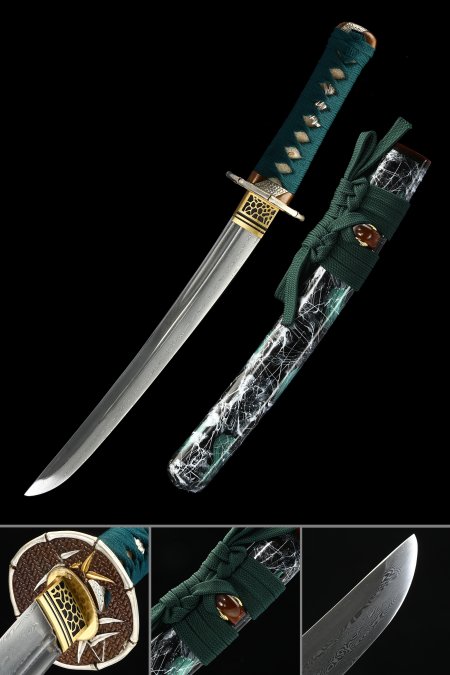
Melaleuca steel - named for the tree whose layered bark it visually resembles - refers to a folded steel with a particularly fine, tight layering pattern achieved through repeated folding and forge-welding of high-carbon steel billets. Compared to standard folded steel, which may show broader, more pronounced grain lines, Melaleuca steel produces a finer, almost textile-like surface texture that becomes especially visible along the blade's flat and near the hamon. The folding process also works out inclusions and distributes carbon more evenly, contributing to both the aesthetic character and the structural consistency of the finished blade. For collectors, this grain pattern is one of the most visually distinctive features a tanto can carry.
What should I know about caring for a lacquered tanto saya?
Piano and traditional lacquer finishes on a saya are durable but not impervious to mishandling. Avoid prolonged exposure to direct sunlight, which can cause the lacquer to fade or micro-crack over time. Do not store the tanto in its saya for extended periods in high-humidity environments - moisture can cause wood to swell, making removal difficult and potentially stressing the lacquer surface. For cleaning, a soft dry cloth is sufficient for the saya exterior; never use solvents or abrasive materials. The blade itself should be wiped clean with a soft cloth after handling and lightly coated with a neutral oil such as choji oil before long-term display storage. Keeping the blade dry protects both the high-carbon steel and the interior of the saya from staining.
Is a tanto a good choice as a display piece compared to a katana?
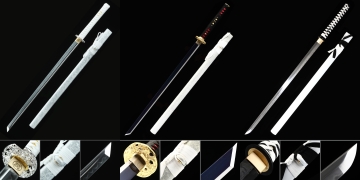
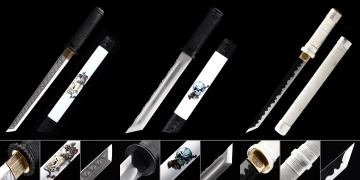
For many collectors, tanto offer distinct display advantages precisely because of their compact form. The shorter blade - typically under 12 inches - makes them ideal for desk stands, small wall mounts, or display cases where a full-length katana would be impractical. Black-and-white saya tanto in particular photograph and display exceptionally well, with the high-contrast lacquer finish remaining legible even at a distance. They also present well as gift pieces, fitting standard gift boxes and shipping more safely than longer blades. If you are building a collection, a tanto complements a katana display naturally - the difference in scale draws the eye and contextualizes both pieces within the broader tradition of Japanese blade craft.
How do I choose between different handle cord colors and tsuba styles?
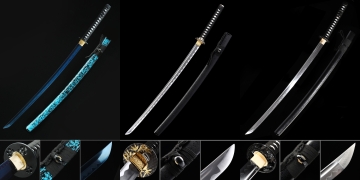
The ito (handle wrap cord) and tsuba (guard) are the two elements that most define the visual character of a tanto beyond the saya. Black cord wrapping reads as traditional and restrained, pairing cleanly with either black or white dominant saya finishes. Teal cord introduces a deliberate contrast that works best when the saya carries a strong graphic pattern - such as the lightning motif - that can anchor the color accent. Gold tsuba profiles, whether Musashi-style or floral-cut, warm up an otherwise monochrome composition and give the piece a ceremonial quality suited to formal display settings. Collectors building thematic displays often choose handle and guard combinations that either mirror or intentionally contrast with the saya's dominant tones, creating a visual tension that rewards close examination.