What makes black and red koshirae significant in katana collecting?
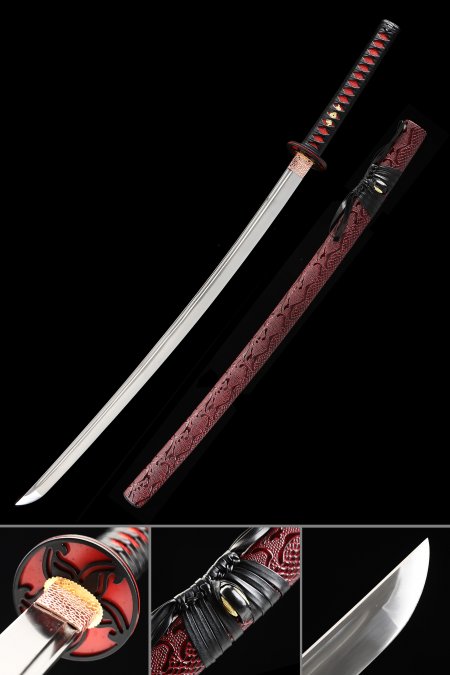
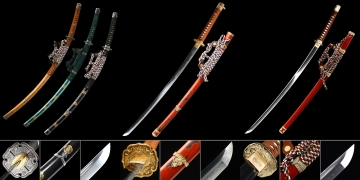
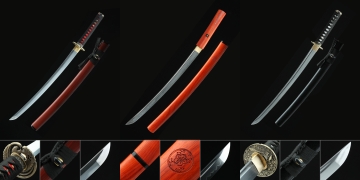
In traditional Japanese sword culture, koshirae - the complete set of external fittings - was never purely decorative. Color choices carried intentional meaning. Black lacquer on saya and fittings was associated with formal discipline and high-grade craftsmanship, often seen on pieces belonging to samurai of rank. Red, applied through lacquer or wrapped materials, signaled ceremonial importance and protective symbolism in many regional traditions. When paired deliberately, black and red create a koshirae that reads as both visually commanding and historically grounded. For collectors, this combination offers more than aesthetic appeal - it provides a meaningful entry point into understanding how Japanese artisans used color as a design language. Display pieces built around authentic color conventions tend to hold stronger visual coherence than those assembled purely for contrast.
How does manganese steel compare to carbon steel for display katana?
Manganese steel and high-carbon steel serve different priorities. High-carbon steel - particularly 1045, 1060, or T10 - is favored when edge retention and differential hardening (hamon) are the primary goals. Manganese steel, by contrast, offers superior resistance to surface deformation and holds its geometric profile well under the conditions typical of display use: occasional handling, removal from saya, and long-term static mounting. For collectors who prioritize structural consistency and a clean, uniform blade finish over a visible hamon, manganese steel is a practical and underrated choice. It also tends to polish to a smooth, even surface that photographs and displays exceptionally well under focused lighting - a genuine consideration for collectors who exhibit their pieces.
How should I store a black and red lacquered saya long-term?
Lacquered and PU leather-wrapped saya are sensitive to humidity fluctuations and prolonged direct light exposure. For long-term storage or display, keep the piece in an environment with stable humidity - ideally between 45% and 55% relative humidity. Avoid placing the saya near heating vents, windows with direct sunlight, or exterior walls that experience temperature swings. For lacquered wood saya specifically, occasional application of a soft microfiber wipe to remove dust prevents particulate buildup that can dull the surface finish over time. The blade inside should be lightly coated with a thin layer of choji oil or a neutral mineral oil before extended storage to prevent any surface oxidation, and the saya interior should be inspected periodically to ensure the wood hasn't shifted in a way that creates friction against the blade.
Is a dragon-embossed saya considered an authentic Japanese design element?
Dragon motifs have a long history in both Japanese and broader East Asian decorative arts, appearing on sword fittings, tsuba, menuki, and lacquerwork across multiple centuries and regional traditions. In Japanese iconography, the dragon - or ryū - symbolizes power, wisdom, and auspicious protection, making it a recurring subject in high-craft decorative applications. Dragon-embossed or carved saya are not standard on classical Japanese production pieces, but they fall within the established tradition of decorative koshirae created for display, ceremony, and gifting purposes. For collectors, a dragon-embossed saya reads as a deliberate artistic choice rather than a historical inaccuracy - particularly when the embossing is well-executed and integrated into the overall color scheme of the mount.
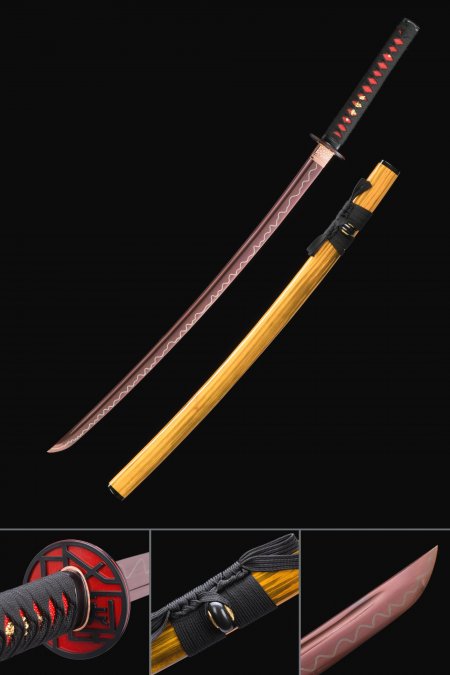
Can a rose gold blade work visually within a black and red koshirae?
Unconventional blade finishes require a strong mount to remain visually coherent, and black and red koshirae provides exactly that. The high-contrast, clearly defined color language of black and red fittings creates a dominant visual framework that can anchor a rose gold blade without the composition feeling arbitrary. The warm metallic tone of a rose gold finish reads as a complement to the red elements in the tsuka wrap and accents, while the black components provide the contrast needed to keep the blade from appearing washed out. For collectors interested in contemporary interpretations of Japanese sword aesthetics - where finish and material innovation are valued alongside traditional form - a rose gold blade in a coordinated black and red mount represents a thoughtful design decision rather than a novelty.