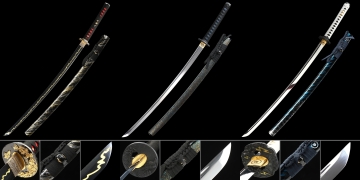
What makes 1095 carbon steel a good choice for a collectible wakizashi?
1095 carbon steel contains roughly 0.95% carbon, placing it at the higher end of the high-carbon spectrum used in Japanese-style sword production. That carbon content translates into a fine, tight grain structure that responds well to heat treatment, allowing makers to produce a blade with a visually striking surface - whether polished bright or finished in a darkened coat. For collectors, 1095 is valued because it behaves similarly to traditional tamahagane in terms of aesthetics and edge geometry, while being far more accessible in cost. It holds detailed geometry along the hamon line and takes a consistent finish across the blade's length. The trade-off versus stainless steel is that 1095 requires light maintenance to prevent oxidation, but most collectors view that ongoing care as part of the ownership experience rather than an inconvenience.
How does a wakizashi differ from a tanto or a short katana?
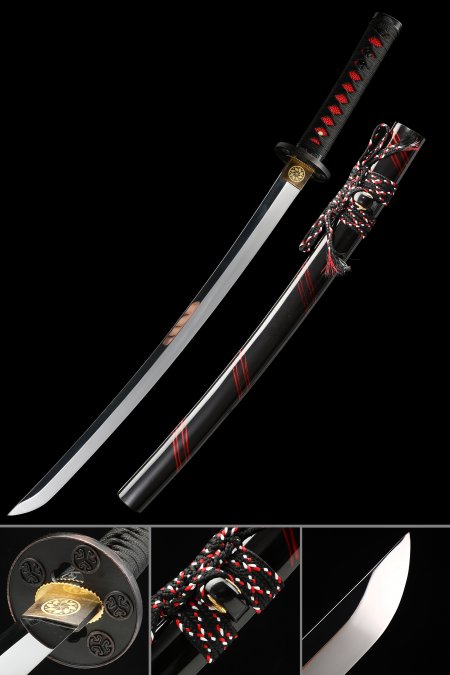
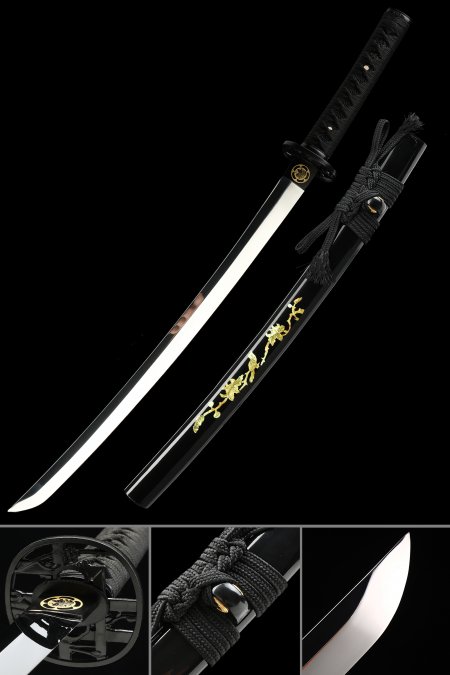
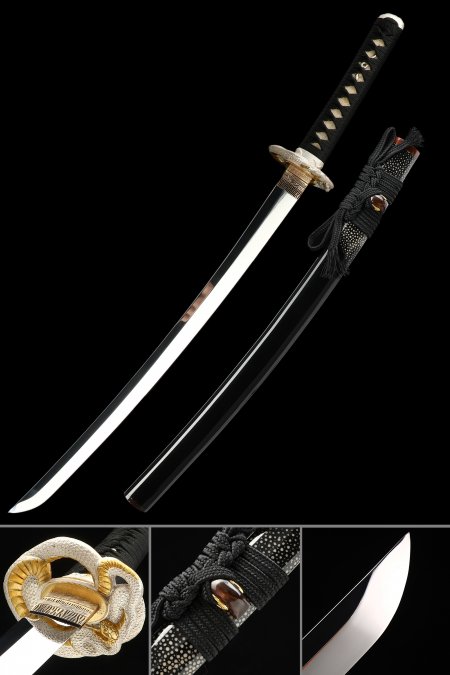
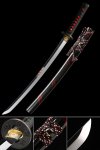
The wakizashi typically measures between 30 and 60 centimeters in blade length, placing it between the tantō (under 30 cm) and the katana (over 60 cm). While the tantō is a compact blade with a more angular tip geometry and minimal curvature, the wakizashi follows the graceful curvature and tapering silhouette of a full katana - it is essentially a scaled-down version of the long sword in both form and construction philosophy. Some listings use the term 'short katana' interchangeably with wakizashi, and while purists distinguish between them, the practical difference for display collectors is mainly one of proportion and mounting style. A wakizashi mounted in traditional Japanese fittings with a full tsuba, same, and ito wrap is a self-contained collector's piece with its own visual identity, not simply a smaller katana.
How should I care for and store a black 1095 wakizashi?
Carbon steel requires more attentive storage than stainless, but the routine is simple once established. Apply a thin film of choji oil or camellia oil to the blade surface every two to three months using a soft cloth or a traditional nuguigami paper. This prevents the surface oxidation that 1095 is susceptible to, especially in humid climates. Store the wakizashi horizontally in its saya in a stable, low-humidity environment - a display case with a silica gel desiccant packet is ideal. Avoid storing the blade in direct sunlight, which fades lacquer saya and degrades cord wrapping over time. Never leave fingerprints on the steel for extended periods, as skin oils are acidic enough to begin surface etching. With these habits, a 1095 wakizashi maintains its finish and collector condition for many years.
What do the different tsuba designs mean for collectors?
The tsuba is the handguard of a Japanese sword, and in a collection context it is often the most expressive single fitting on the piece. A snake motif tsuba draws from Japanese and broader East Asian symbolism - the serpent represents transformation, wisdom, and cyclical time, giving the blade a mythological narrative that resonates strongly in display contexts. A chrysanthemum tsuba references kiku, the sixteen-petaled imperial flower of Japan that appears on the Imperial Seal - it signals refinement and cultural authenticity. For collectors assembling a themed display, choosing tsuba designs intentionally creates visual and narrative coherence across multiple pieces. Alloy-cast tsuba are also more dimensionally detailed than stamped versions, and the weight and texture of a well-made alloy tsuba adds a tactile quality that is immediately apparent when handling the piece.
Is a black wakizashi a good gift for a Japanese sword enthusiast?
A black 1095 carbon steel wakizashi is one of the more considered gifts you can choose for a collector interested in Japanese sword aesthetics. Unlike a katana, it is compact enough to display in smaller spaces - a wall mount, a desktop stand, or a display case - which makes it practical for enthusiasts who may not have room for a full-length piece. The black lacquer saya and cord-wrapped handle present exceptionally well visually, even before the blade is considered. For someone already owning a katana, a matching-aesthetic wakizashi completes the daishō pairing and adds genuine depth to a display. The 1095 steel construction and ornate fittings also signal that the piece is a meaningful collectible rather than a novelty item, which is the distinction serious enthusiasts appreciate most when receiving a gift in this category.